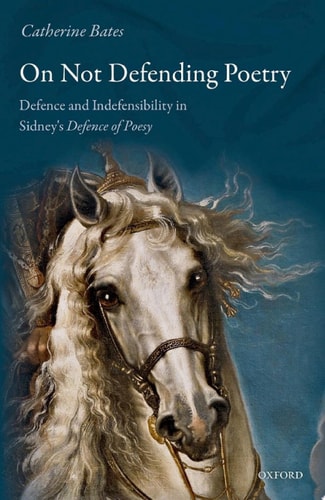
On Not Defending Poetry: Defence and Indefensibility in Sidney's Defence of Poesy
0
0
As an Amazon Associate and affiliate partner, Menrva Books earns from qualifying purchases. Learn more
Author Description
Sidney's Defence of Poesy--the foundational text of English poetics--is generally taken to present a model of poetry as ideal: the poet depicts ideals of human conduct and readers are inspired to imitate them. Catherine Bates sets out to challenge this received view. Attending very closely to Sidney's text, she identifies within it a model of poetry that is markedly at variance from the one presumed, and shows Sidney's text to be feeling its way toward a quite different--indeed, a de-idealist--poetics. Following key theorists of the new economic criticism, On Not Defending Poetry shows how idealist poetics, like the idealist philosophy on which it draws, is complicit with the money form and with the specific ills that attend upon it: among them, commodification, fetishism, and the abuse of power. Against culturally approved models of poetry as profitable—as benefiting the individual and the state, as providing (in the form of intellectual, moral, and social capital) a quantifiable yield—the Defence reveals an unexpected counter-argument: one in which poetry is modelled, rather, as pure expenditure, a free gift, a net loss. Where a supposedly idealist Defence sits oddly with Sidney's literary writings—which depict human behaviour that is very far from ideal—a de-idealist Defence does not. In its radical reading of the Defence, this book thus makes a decisive intervention in the field of early modern studies, while raising larger questions about a culture determined to quantify the 'value' of the humanities and to defend the arts on those grounds alone.
Menrva's Summary
THE THESIS
This book investigates whether Sir Philip Sidney’s 'Defence of Poesy' actually promotes an idealist model of poetry or if it functions as a critique of the commodification of art. Catherine Bates, a scholar of Renaissance literature, utilizes close textual analysis and economic criticism to argue that Sidney’s work rejects the notion of poetry as a profitable asset. She posits that Sidney instead models poetry as a form of pure expenditure and a 'free gift' that resists the quantifiable value systems of the state and the market.
THE SCOPE MAP
What You Will Find
- A re-evaluation of Sidney's 'Defence of Poesy' through the lens of new economic criticism.
- Theoretical frameworks concerning commodification, fetishism, and the abuse of power in early modern texts.
- Comparative analysis between Sidney's theoretical claims and his own literary practice.
Scope Limits
- The study does not provide a general biography of Sidney or a comprehensive history of Elizabethan literature.
- It focuses specifically on the 'Defence' rather than an exhaustive survey of all Renaissance poetic treatises.
THE AUTHORITY PERSPECTIVE
Scholars in the field of early modern studies recognize this work as a significant intervention that challenges long-standing interpretations of Sidney’s poetics. Readers frequently note the academic density of the prose and the rigor with which Bates applies economic theory to historical literary texts.
Page Count:
317
Publication Date:
2017-01-01
Publisher:
OUP Oxford
ISBN-10:
0192512560
ISBN-13:
9780192512567
Philosophy
Renaissance
English & College Success
Literary Criticism
English
Poetry
English literature
Poetics
Early Modern
Community Tags
Similar Books