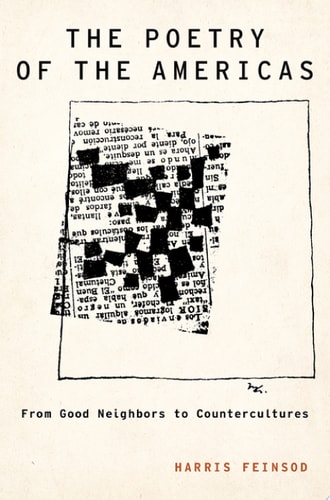
The Poetry of the Americas: From Good Neighbors to Countercultures
0
0
As an Amazon Associate and affiliate partner, Menrva Books earns from qualifying purchases. Learn more
Author Description
The Poetry of the Americas offers a lively and detailed history of relations among poets in the US and Latin America, spanning three decades from the Good Neighbor diplomacy of World War II through the Cold War cultural policies of the late 1960s. Connecting works by Martín Adán, Elizabeth Bishop, Paul Blackburn, Jorge Luis Borges, Julia de Burgos, Ernesto Cardenal, Jorge Carrera Andrade, Allen Ginsberg, Langston Hughes, José Lezama Lima, Pablo Neruda, Charles Olson, Octavio Paz, Heberto Padilla, Wallace Stevens, Derek Walcott, William Carlos Williams, and many others, Feinsod reveals how poets of many nations imagined a "poetry of the Americas" that linked multiple cultures, even as it reflected the inequities of the inter-American political system. This account offers a rich contextual study of the state-sponsored institutions and the countercultural networks that sustained this poetry, from Nelson Rockefeller's Office of the Coordinator for Inter-American Affairs to the mid-1960s avant-garde scene in Mexico City. This innovative literary-historical project enables new readings of such canonical poems as Stevens's "Notes Toward a Supreme Fiction" and Neruda's "The Heights of Macchu Picchu," but it positions these alongside lesser known poetry, translations, anthologies, literary journals and private correspondences culled from library archives across the Americas. The Poetry of the Americas thus broadens the horizons of reception and mutual influence--and of formal, historical, and political possibility--through which we encounter midcentury American poetry, recasting traditional categories of "U.S." or "Latin American" literature within a truly hemispheric vision.
Menrva's Summary
THE THESIS
This book investigates how poets across the Americas constructed a hemispheric literary identity that navigated the complex intersection of state-sponsored diplomacy and grassroots countercultural movements. Harris Feinsod, a scholar of comparative literature, utilizes extensive archival research, including private correspondence and literary journals, to argue that mid-century poetry was deeply embedded in the political and cultural tensions of the inter-American system. By examining the work of figures ranging from Elizabeth Bishop to Pablo Neruda, the text provides a framework for understanding how poetic exchange functioned as both a tool of institutional influence and a medium for resistance.
THE SCOPE MAP
What You Will Find
- A historical analysis of poetic relations between the US and Latin America from the 1940s to the 1960s.
- Examination of state-sponsored cultural initiatives like the Office of the Coordinator for Inter-American Affairs.
- Comparative readings of canonical and lesser-known works within a hemispheric context.
Scope Limits
- The study focuses primarily on the mid-twentieth century and does not provide an exhaustive history of all inter-American poetic traditions.
- The analysis is limited to the specific political and avant-garde networks active during the Cold War era.
THE AUTHORITY PERSPECTIVE
Scholars and critics recognize this work as a significant contribution to the study of hemispheric modernism and transnational literary history. Readers frequently note the academic density of the prose and the depth of the archival research presented throughout the text.
Page Count:
437
Publication Date:
2017-01-01
Publisher:
Oxford University Press
ISBN-10:
0190682027
ISBN-13:
9780190682026
Poetry
History
Cultural History
English
English & College Success
American History
Literary Criticism
American
Modernism
Poetry
Latin American
Cultural Anthropology
United States
Community Tags
Similar Books