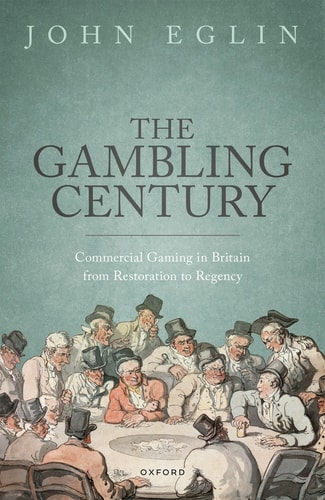
The Gambling Century: Commercial Gaming in Britain from Restoration to Regency
0
0
As an Amazon Associate and affiliate partner, Menrva Books earns from qualifying purchases. Learn more
Author Description
Gambling captures as nothing else the drama of the “long eighteenth century” between the age of religious wars and the age of revolutions. The society that was confronted with games of chance pursued as commercial ventures also came to grips with unprecedented social mobility, floated by new wealth from new sources that created fortunes from trade in sugar, cotton, ivory, silk, tea, or enslaved human beings. Likewise, play for money was prominent in the public imagination as money itself, deployed through an ever expanding and ever more sophisticated range of mechanisms, increasingly invaded public awareness, as when prospective spouses in period fiction were rated in terms of annual income as if they were municipal bonds. Similarly, the archetypal figure of the gambler captured the imagination of the public in fiction, media, and politics. At the same time, new interest in science, technology, engineering, and mathematics - encouraged and bankrolled by those in power - fostered a new and unprecedented appreciation for mathematical probability and its applications, opening the possibility that games of chance might be pursued as a profitable commercial venture.The Gambling Century focuses like no previous work on those who enabled, facilitated, and profited from gambling, as well as on efforts to regulate or outlaw it. Using extensive archival material as well as printed sources, it follows its subjects from the Court to the coffeehouse, to private clubs and “at homes” in townhouses, all of which prefigure that quintessentially modern gambling space, the casino.
Menrva's Summary
THE THESIS
This work investigates how the rise of commercial gambling in Britain between the Restoration and the Regency reflected broader shifts in social mobility, economic expansion, and the public understanding of probability. John Eglin, a historian specializing in the eighteenth century, utilizes a wide array of archival records and contemporary printed sources to argue that the professionalization of gaming was inextricably linked to the era's new wealth and evolving financial mechanisms. He positions the gambler as a central figure in the period's political and social imagination, illustrating how the pursuit of profit through chance mirrored the era's growing interest in mathematics and commercial speculation.
THE SCOPE MAP
What You Will Find
- Analysis of the transition from informal betting to organized commercial gaming ventures.
- Examination of the influence of new wealth from trade in commodities like sugar, cotton, and tea.
- Exploration of the intersection between mathematical probability, science, and gambling.
- Case studies of gambling environments ranging from royal courts to private clubs and coffeehouses.
Scope Limits
- The study does not focus on the psychological motivations of individual gamblers.
- It does not provide a comprehensive history of gambling outside of the British Isles.
THE AUTHORITY PERSPECTIVE
Scholars recognize this text as a detailed examination of the commercial and social structures that enabled the growth of gaming in eighteenth-century Britain. Readers frequently note the depth of the archival research and the author's ability to connect gambling practices to the wider economic transformations of the period.
Page Count:
288
Publication Date:
2024-01-01
Publisher:
Oxford University Press
ISBN-10:
0192888196
ISBN-13:
9780192888198
History
Great Britain
Europe
Social History
British History
Economic History
Gambling
Community Tags
Similar Books