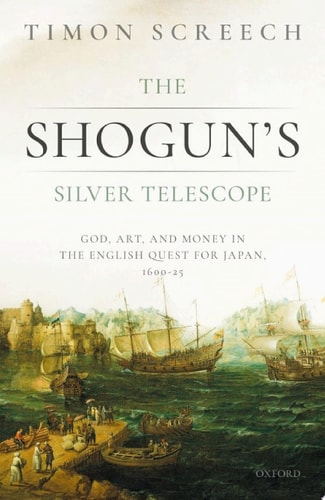
The Shogun's Silver Telescope and the Cargo of the New Year's Gift: God, Art & Money in the English Quest for Japan, 1600-1625
0
0
As an Amazon Associate and affiliate partner, Menrva Books earns from qualifying purchases. Learn more
Author Description
The East India Company, founded in London in 1600, was originally a spice trading organisation. But its governors soon began to think bigger. After a decade, they started to plan voyages to more fabulous places, notably India and Japan. Rich in silver, Japan was a desirable trading partner; crucially, it was also cold in winter. England's main export was woollen cloth, which would not sell in hot places, so the Company envisaged adding to its spice runs by sailing back and forth to Japan, exchanging wool for silver. Maps suggested that this could be done quickly, above Russian. But these maps also made Japan twenty times too large, the size of India in fact. Knowing the Spanish and Portuguese had preceded them, the Company prepared a special present for its first extended sailing to India and Japan. In the end, the Company missed India, but got to Japan in 1613. The Shogun, the military dictator of Japan, was presented with a silver telescope in the name of King James. It was the first telescope ever to leave Europe and the first made as a presentation item. Before this initial ship had even returned, the Company dispatched another, named the New Year's Gift, with an equally stunning cargo: almost 100 oil paintings. These would be given and sold to the Indian and Japanese courts. This book looks at the formation and history of the Company, but mostly examines the meaning of these two extraordinary cargoes. What were they supposed to mean, and what effect did they have on quizzical Asian rulers?
Menrva's Summary
THE THESIS
This work investigates the intersection of early modern diplomacy, global commerce, and cultural exchange through the specific lens of the East India Company's initial trade missions to Japan. Timon Screech, a scholar of Japanese history and art, utilizes primary archival records and historical cartography to argue that the exchange of European luxury goods—specifically a silver telescope and a collection of oil paintings—served as a calculated, albeit misunderstood, instrument of political and economic soft power during the early seventeenth century.
THE SCOPE MAP
What You Will Find
- Analysis of the East India Company's strategic shift from spice trading to broader Asian markets.
- Examination of the role of European art as a diplomatic commodity in the courts of the Shogun.
- Historical context regarding the inaccuracies of early seventeenth-century cartography and its impact on trade route planning.
Scope Limits
- The study focuses primarily on the period between 1600 and 1625.
- The narrative does not provide a comprehensive history of the East India Company beyond its early interactions with Japan.
THE AUTHORITY PERSPECTIVE
Scholars and historians frequently commend this text for its meticulous archival research and its ability to synthesize art history with economic history. Experts highlight the book as a significant contribution to the study of early modern cross-cultural encounters and the material culture of global trade.
Page Count:
320
Publication Date:
2020-01-01
Publisher:
OUP Oxford
ISBN-10:
0192568027
ISBN-13:
9780192568021
History
Maritime history
Art History
British History
Economic History
Japan History
International relations
Asian History
Community Tags
Similar Books