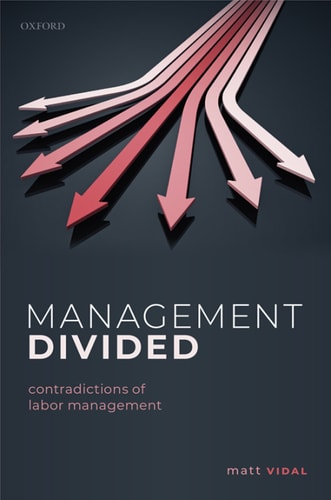
Management Divided: Contradictions of Labor Management
0
0
As an Amazon Associate and affiliate partner, Menrva Books earns from qualifying purchases. Learn more
Author Description
One of the central dynamics shaping organizations today is a contradiction managers face between ensuring workforce discipline and harnessing worker creativity. This contradiction has been intensifying over the last four decades as employee involvement has become increasingly important in response to rapid technological change, requirements for flexibility, and demands for continuous improvement. In manufacturing, global best practice includes lean production with substantive worker empowerment; cross-training in enlarged tasks and inclusion in problem solving and decision making. Yet, many managers instead face these conflicting pressures by training workers in narrow tasks and using them exclusively for manual labor. In this richly evidenced study of American manufacturing, Matt Vidal presents a synthetic theory called 'organizational political economy', integrating concepts from organization theory into a classical marxist framework. This theory emphasizes how contradictory developments - conflicting pressures and competing logics of labor management - lead management to be divided. Some managers adopt best practice by substantively empowering their workforce while others settle for good enough. Capitalist management is increasingly a source of organizational inefficiency. This argument is not limited to manufacturing. Managers experience contradictory pressures - for standardization versus discretion, deskilling versus upskilling - in a wide range of occupations including education, healthcare, software development, and many more.
Menrva's Summary
THE THESIS
This book investigates the fundamental contradiction managers face between the need for workforce discipline and the requirement to harness employee creativity in modern organizations. Matt Vidal, a sociologist specializing in labor and organizational dynamics, utilizes a synthesis of organization theory and classical Marxist frameworks to propose a theory of 'organizational political economy.' He argues that these conflicting pressures lead to a bifurcation in management styles, where some firms adopt substantive empowerment while others rely on deskilling and narrow task assignment, ultimately resulting in systemic inefficiency.
THE SCOPE MAP
What You Will Find
- A theoretical framework integrating organizational theory with Marxist political economy
- Analysis of lean production models and worker empowerment strategies
- Comparative study of management practices across American manufacturing firms
- Extension of the theory to service and knowledge-based sectors like healthcare and software
Scope Limits
- The study focuses primarily on the American industrial context
- It does not provide a comprehensive manual for individual managerial implementation
THE AUTHORITY PERSPECTIVE
Scholars in labor sociology and management studies identify this work as a rigorous contribution to the understanding of workplace contradictions. Readers frequently note the academic density of the prose and the depth of the theoretical synthesis provided by the author.
Page Count:
385
Publication Date:
2022-01-01
Publisher:
OUP Oxford
ISBN-10:
0192514474
ISBN-13:
9780192514479
Economics
Sociology
Labor Studies
Management
Organizational Theory
Manufacturing
Community Tags
Other Editions(2)
Similar Books