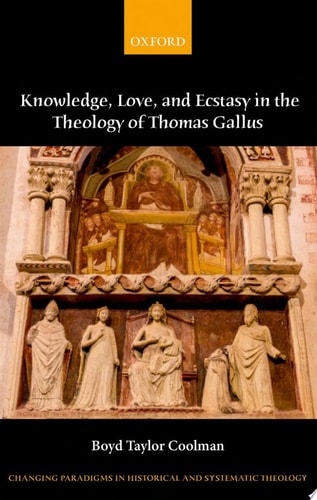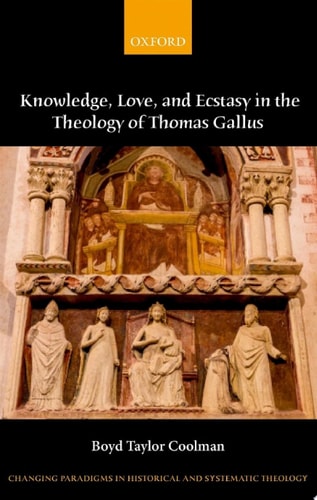
Knowledge, Love, and Ecstasy in the Theology of Thomas Gallus
0
0
As an Amazon Associate and affiliate partner, Menrva Books earns from qualifying purchases. Learn more
Author Description
Knowledge, Love, and Ecstasy in the Theology of Thomas Gallus provides the first full study of Thomas Gallus (d. 1246) in English and represents a significant advance in his distinctive theology. Boyd Taylor Coolman argues that Gallus distinguishes, but never separates and intimately relates two international modalities in human consciousness: the intellective and the affective, both of which are forms of cognition. Coolman shows that Gallus conceives these two cognitive modalities as co-existing in an interdependent manner, and that this reciprocity is given a particular character by Gallus anthropological appropriation of the Dionysian concept of hierarchy. Because Gallus conceives of the soul as hierarchized on the model of the angelic hierarchy, the intellect-affect relationship is fundamentally governed by the dynamism of a Dionysian hierarchy, which has two simultaneous trajectories: ascending and descending. Two crucial features are noteworthy in this regard: in ascending, firstly, the lower is subsumed by the higher; in descending, secondly, the higher communicates with the lower, according to the nature of the lower. When Gallus posits a higher, affective cognitio above an intellective cognitio at the highest point in the ascent, accordingly, this higher affective form both builds upon and sublimates the lower intellective form. At the same time, this affective cognitio descends back down into the soul, both enriching its properly intellective capacity and also renewing the ascending movement in love. For Gallus, then, in the hierarchized soul a dynamic mutuality between intellect and affect emerges, which he construes as a spiralling motion, by which the soul unceasingly stretches beyond itself, ecstatically, in knowing and loving God.
Menrva's Summary
THE THESIS
This study investigates the theological framework of Thomas Gallus to determine how he reconciles the intellective and affective modalities of human consciousness in relation to the divine. Boyd Taylor Coolman, a scholar of medieval theology, analyzes Gallus's 13th-century writings to demonstrate how the soul functions through a hierarchical structure. By utilizing the Dionysian model of hierarchy, Coolman argues that Gallus posits a dynamic, reciprocal relationship between knowing and loving God, where the affective capacity eventually transcends and enriches the intellective.
THE SCOPE MAP
What You Will Find
- An examination of the 13th-century theological contributions of Thomas Gallus.
- A detailed analysis of the Dionysian concept of hierarchy applied to human anthropology.
- A conceptual framework explaining the interaction between intellective and affective cognition.
Scope Limits
- The study is restricted to the theological output of Thomas Gallus and does not provide a broad survey of all medieval scholasticism.
- The text focuses primarily on the specific cognitive modalities defined by Gallus rather than a general history of medieval mysticism.
THE AUTHORITY PERSPECTIVE
Scholars recognize this work as the primary English-language resource for understanding the specific theological contributions of Thomas Gallus. Readers frequently note the academic density of the prose, which requires a foundational understanding of scholastic terminology to fully grasp the author's arguments.
Page Count:
284
Publication Date:
2017-01-01
Publisher:
OUP Oxford
ISBN-10:
0192518135
ISBN-13:
9780192518132
Philosophy
Religion
Christian mysticism
Theology doctrinal
Theology
History of religion