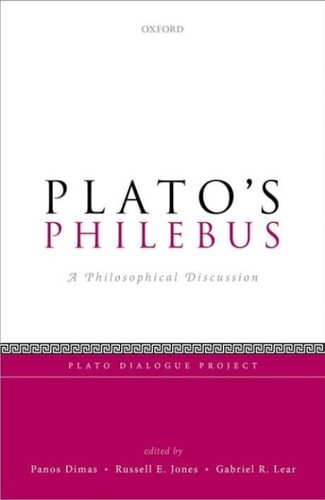
Plato's Philebus: A Philosophical Discussion
0
0
As an Amazon Associate and affiliate partner, Menrva Books earns from qualifying purchases. Learn more
Author Description
The Philebus is an extraordinarily creative and profound examination of what makes for a good human life, containing some of Plato's most sophisticated discussions of moral psychology, knowledge, metaphysics, and philosophical methodology. The Philebus had a far greater influence on Aristotle's ethics than the frequently studied Republic - yet historians of philosophical ethics have relatively neglected it and existing commentaries tend to emphasize certain aspects at the expense of others. This edited volume, the first of its kind, brings together leading scholars of ancient philosophy to take a fresh and comprehensive look at this important work. Each essay focuses on a relatively brief section of the Philebus and discusses the passages methodically, covering topics such as pleasure, knowledge, philosophical method, and the human good in detail. The result is not and is not intended to be a commentary, nor does it aim to present a unified interpretation. It is instead a series of close, original philosophical examinations, often in conversation with each other, which together provide continuous coverage of the Philebus. This reference work, a useful resource for teaching and studying, is valuable reading for researchers, scholars, graduate students, and advanced undergraduates interested in Plato, ancient Greek ethics, and in the history of ethics.
Menrva's Summary
THE THESIS
This volume investigates the central question of what constitutes a good human life through a rigorous re-examination of Plato's Philebus. The editors, Gabriel R. Lear, Panos Dimas, and Russell E. Jones, curate a collection of essays from leading scholars in ancient philosophy to address the historical neglect of this dialogue. By focusing on moral psychology, knowledge, and philosophical methodology, the contributors provide a comprehensive framework for understanding the text's influence on Aristotelian ethics and its unique place in the Platonic corpus.
THE SCOPE MAP
What You Will Find
- Detailed analysis of pleasure, knowledge, and the human good
- Methodical examination of specific passages within the Philebus
- Scholarly discourse on the dialogue's influence on Aristotle
- Original philosophical arguments from multiple academic perspectives
Scope Limits
- Does not function as a traditional, unified commentary
- Does not attempt to present a single, cohesive interpretation of the dialogue
THE AUTHORITY PERSPECTIVE
Scholars and graduate students identify this volume as a significant resource for filling the historical gap in Philebus studies. Experts highlight the text's utility for advanced research and classroom instruction due to its methodical, section-by-section approach to complex philosophical themes.
Page Count:
304
Publication Date:
2019-01-01
Publisher:
OUP Oxford
ISBN-10:
0192525077
ISBN-13:
9780192525079
Philosophy
History & Surveys
Plato
Metaphysics
Academic
Ethics
Community Tags
Similar Books