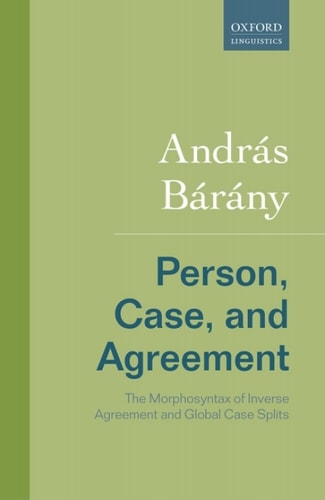
Person, Case, and Agreement: The Morphosyntax of Inverse Agreement and Global Case Splits
0
0
As an Amazon Associate and affiliate partner, Menrva Books earns from qualifying purchases. Learn more
Author Description
This book provides both language-specific and cross-linguistic comparative analyses of phenomena relating to person, case and case-marking, and agreement. It offers an explicit and detailed analysis of differential object marking in Hungarian, and shows that the same general type of analysis can account for related phenomena in unrelated languages such as Kashmiri and Sahaptin. In Hungarian, the person of both the subject and the object determines verbal morphology, while in Kashmiri and Sahaptin, person determines object case-marking and subject case-marking, respectively. András Bárány adopts broadly the same analysis for these three languages, focusing on how person and agreement influence case-marking. In contrast, the final chapters examine how case-marking influences agreement and show how to account for both orders of interaction. Finally, the author discusses typological generalizations based on the interaction of case and agreement and shows how only the attested patterns of case-marking and agreement in ditransitive clauses are predicted. The book combines data from eight different language families with theory and explicit analyses, and will be of interest to both formal and data-oriented linguists and typologists alike.
Menrva's Summary
THE THESIS
This book investigates the complex interplay between person, case, and agreement systems to determine how these grammatical features interact across diverse language families. András Bárány, a specialist in formal syntax and typology, utilizes a comparative framework to analyze differential object marking and verbal morphology. By examining specific data from Hungarian, Kashmiri, and Sahaptin, the author argues that a unified analytical approach can explain how person features influence case-marking and how case-marking subsequently influences agreement patterns.
THE SCOPE MAP
What You Will Find
- Detailed syntactic analysis of differential object marking in Hungarian.
- Comparative studies of Kashmiri and Sahaptin regarding subject and object case-marking.
- Theoretical models for the interaction between person-based agreement and case-marking.
- Typological generalizations regarding ditransitive clause structures across eight language families.
Scope Limits
- The text focuses primarily on formal syntactic and morphological frameworks rather than sociolinguistic or historical language evolution.
- The analysis is restricted to specific patterns of inverse agreement and global case splits rather than providing a comprehensive survey of all global language structures.
THE AUTHORITY PERSPECTIVE
Linguists and typologists identify this work as a rigorous contribution to the study of morphosyntax, particularly for its ability to bridge language-specific data with broader theoretical models. Readers frequently note the technical density of the prose, which is intended for an audience of formal and data-oriented researchers in the field of linguistics.
Page Count:
240
Publication Date:
2017-01-01
Publisher:
OUP Oxford
ISBN-10:
0192526200
ISBN-13:
9780192526205
English
Morphology
Linguistics
English & College Success
Syntax
Comparative linguistics
Community Tags
Similar Books