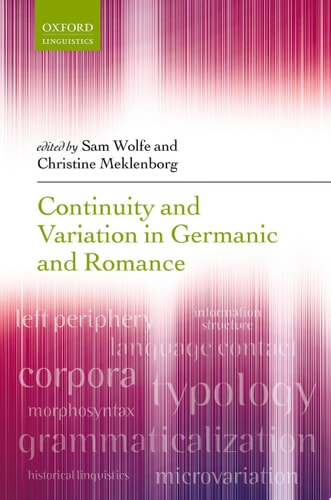
Continuity and Variation in Germanic and Romance
0
0
As an Amazon Associate and affiliate partner, Menrva Books earns from qualifying purchases. Learn more
Author Description
This volume offers a range of synchronic and diachronic case studies in comparative Germanic and Romance morphosyntax. These two language families, spoken by over a billion people today, have played a central role in linguistic research, but many significant questions remain about the relationship between them. Following an introduction that sets out the methodological, empirical, and theoretical background to the book, the volume is divided into three parts that deal with the morphosyntax of subjects and the inflectional layer; inversion, discourse pragmatics, and the left periphery; and continuity and variation beyond the clause. The contributors adopt a diverse range of approaches, making use of the latest digitized corpora and presenting a mixture of well-known and under-studied data from standard and non-standard Germanic and Romance languages. Many of the chapters challenge received wisdom about the relationship between these two important language families. The volume will be an indispensable resource for researchers and students in the fields of Germanic and Romance linguistics, historical and comparative linguistics, and morphosyntax.
Menrva's Summary
THE THESIS
This volume investigates the structural relationships and linguistic evolution between Germanic and Romance language families through a series of comparative morphosyntactic studies. The contributors, a group of specialized linguists, utilize both established and digitized corpus data to challenge traditional assumptions regarding the historical and synchronic connections between these two major language groups.
THE SCOPE MAP
What You Will Find
- Comparative analysis of subject morphosyntax and inflectional layers
- Examination of inversion, discourse pragmatics, and left periphery structures
- Research on continuity and variation beyond the clause level
- Application of digitized corpora to both standard and non-standard language varieties
Scope Limits
- The volume does not provide a comprehensive history of all Germanic or Romance languages
- It focuses specifically on morphosyntactic phenomena rather than phonological or lexical evolution
THE AUTHORITY PERSPECTIVE
Experts identify this volume as a significant contribution to comparative linguistics, particularly for its focus on under-studied data sets. Researchers frequently note the technical density of the prose, making it a specialized resource for advanced students and academics in the field.
Page Count:
416
Publication Date:
2021-01-01
Publisher:
OUP Oxford
ISBN-10:
0192578057
ISBN-13:
9780192578051
English & College Success
Historical linguistics
Linguistics
Morphosyntax
English
Comparative linguistics
Germanic Languages
Community Tags
Similar Books