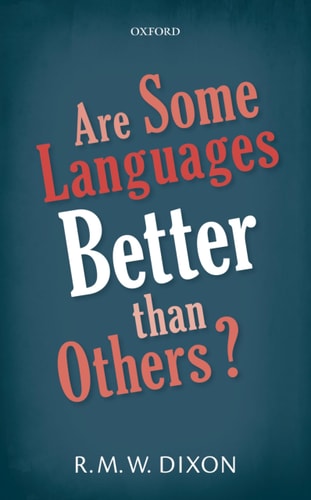
Are Some Languages Better than Others?
0
0
As an Amazon Associate and affiliate partner, Menrva Books earns from qualifying purchases. Learn more
Author Description
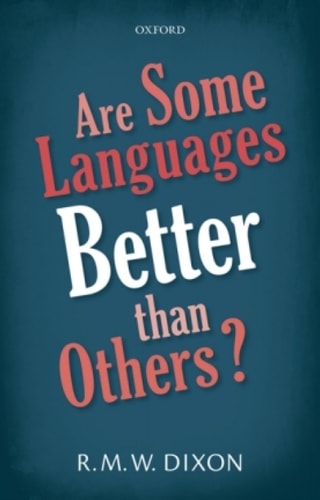
This book sets out to answer a question that many linguists have been hesitant to ask: are some languages better than others? Can we say, for instance, that because German has three genders and French only two, German is a better language in this respect? Jarawara, spoken in the Amazonian jungle, has two ways of showing possession: one for a part (e.g. 'Father's foot') and the other for something which is owned and can be given away or sold (e.g. 'Father's knife'); is it thus a better language, in this respect, than English, which marks all possession in the same way? R. M. W. Dixon begins by outlining what he feels are the essential components of any language, such as the ability to pose questions, command actions, and provide statements. He then discusses desirable features including gender agreement, tenses, and articles, before concluding with his view of what the ideal language would look like - and an explanation of why it does not and probably never will exist. Written in the author's usual accessible and engaging style, and full of personal anecdotes and unusual linguistic phenomena, the book will be of interest to all general language enthusiasts as well as to a linguistics student audience, and particularly to anyone with an interest in linguistic typology.
Menrva's Summary
THE THESIS
This book investigates the provocative question of whether certain languages possess inherent superiority over others based on their grammatical structures and expressive capabilities. R. M. W. Dixon, a distinguished linguist known for his extensive fieldwork, utilizes his deep expertise in linguistic typology to challenge the notion of linguistic hierarchy. He constructs a framework that evaluates language components—such as gender systems, tense, and possession—to determine if specific features offer functional advantages, ultimately arguing against the existence of a single ideal language.
THE SCOPE MAP
What You Will Find
- Comparative analysis of grammatical features across diverse language families
- Examination of specific linguistic phenomena like gender agreement and possession marking
- Theoretical exploration of the components necessary for human communication
- Personal anecdotes from the author's extensive field research in the Amazon
Scope Limits
- The text does not provide a comprehensive history of all world languages
- It avoids prescriptive linguistic policies or political commentary on language status
THE AUTHORITY PERSPECTIVE
Experts and students of linguistics frequently cite this work as an accessible entry point into the complex field of linguistic typology. Readers often note that the author's conversational tone effectively bridges the gap between academic rigor and general interest.
Page Count:
288
Publication Date:
2016-01-01
Publisher:
OUP Oxford
ISBN-10:
0191079413
ISBN-13:
9780191079412
Non-Fiction
Language
Linguistic Typology
English
English & College Success
Linguistics
Comparative linguistics