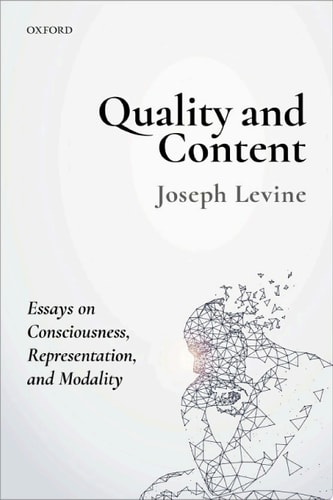
Quality and Content: Essays on Consciousness, Representation, and Modality
0
0
As an Amazon Associate and affiliate partner, Menrva Books earns from qualifying purchases. Learn more
Author Description
Joseph Levine draws together a series of essays in which he has developed his distinctive approach to philosophy of mind. He explores such topics as the "phenomenal concept strategy" to defend materialism from anti-materialist intuitions, the doctrine of representationalism about phenomenal character, the modal argument against materialism, the nature of demonstrative thought, and cognitive phenomenology. Levine argues that the phenomenal concept strategy cannot work and that representationalism has certain fatal flaws, at least if it is to be joined to a materialist metaphysics. On the other hand, he defends materialism from the modal argument, contending that it relies on a questionable conflation of semantic and metaphysical issues. Levine also provides a naturalistic theory of demonstrative thought, criticizing certain philosophical arguments involving that notion in the process. All of the essays in some way respond to various materialist attempts to close the "explanatory gap" as well as outline a different conception of conscious experience that would accommodate the gap. Levine connects his work with related themes in contemporary psychology and with such hot philosophical topics as cognitive phenomenology.
Menrva's Summary
THE THESIS
This collection of essays investigates the persistent explanatory gap between physicalist accounts of the brain and the subjective nature of conscious experience. Joseph Levine, a prominent philosopher of mind, synthesizes decades of research to challenge prevailing materialist frameworks. By analyzing the limitations of the phenomenal concept strategy and representationalism, he constructs a nuanced argument that attempts to reconcile naturalism with the qualitative reality of consciousness.
THE SCOPE MAP
What You Will Find
- Critical analysis of the phenomenal concept strategy and its failure to bridge the explanatory gap.
- Examination of representationalism and its compatibility with materialist metaphysics.
- Theoretical framework for demonstrative thought and its role in cognitive phenomenology.
- Rebuttal of the modal argument against materialism through the lens of semantic and metaphysical distinctions.
Scope Limits
- The text does not provide a comprehensive history of philosophy of mind, focusing instead on specific contemporary debates.
- It does not offer a complete, finished theory of consciousness, but rather outlines a framework for future inquiry.
THE AUTHORITY PERSPECTIVE
Experts recognize this volume as a significant contribution to the ongoing debate regarding the limits of physicalism. Readers frequently note the academic density of the prose, which requires a strong background in analytic philosophy to fully grasp the technical arguments presented.
Page Count:
256
Publication Date:
2018-01-01
Publisher:
OUP Oxford
ISBN-10:
0192520466
ISBN-13:
9780192520463
Philosophy
Metaphysics
Epistemology
Philosophy of
Mind & Body
Community Tags
Similar Books