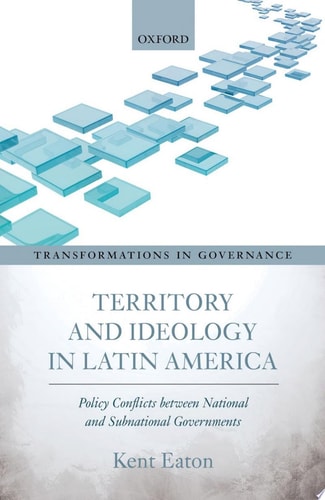
Territory and Ideology in Latin America
0
0
As an Amazon Associate and affiliate partner, Menrva Books earns from qualifying purchases. Learn more
Author Description
Around the world, familiar ideological conflicts over the market are becoming increasingly territorialized in the form of policy conflicts between national and subnational governments. Thanks to a series of trends like globalization, democratization, and especially decentralization, subnational governments are now in a position to more effectively challenge the ideological orientation of the national government. The book conceptualizes these challenges as operating in two related but distinct modes. The first stems from elected subnational officials who use their authority, resources, and legitimacy to design, implement, and defend subnational policy regimes that deviate ideologically from national policy regimes. The second occurs when these same officials use their authority, resources, and legitimacy to question, oppose, and alter the ideological content of national policy regimes. The book focuses on three similarly-situated countries in Latin America where these two types of policy challenges met different fates; neither challenge succeeded in Peru, both succeeded in Bolivia, and Ecuador experienced an intermediate outcome marked by the success of the first type of challenge (i.e. the defence of a deviant, neoliberal subnational policy regime) and the failure of the second (i.e. the inability to alter a statist national policy regime). Derived from the in-depth study of these countries, the book's theoretical argument emphasizes three critical variables: 1) the structural significance of the territory over which subnational elected officials preside, 2) the level of institutional capacity they can harness, and 3) the strength of the societal coalitions they can build both within and across subnational jurisdictions. Transformations in Governance is a major new academic book series from Oxford University Press. It is designed to accommodate the impressive growth of research in comparative politics, international relations, public policy, federalism, environmenta
Menrva's Summary
THE THESIS
How do subnational governments in Latin America effectively challenge the ideological orientation of national policy regimes? Kent Eaton, a scholar of comparative politics, investigates the intersection of decentralization and ideological conflict. He argues that the success of subnational resistance against national policy is determined by the structural significance of the territory, the institutional capacity of local officials, and the strength of societal coalitions supporting these deviations.
THE SCOPE MAP
What You Will Find
- Comparative analysis of political decentralization in Peru, Bolivia, and Ecuador.
- A two-mode framework for understanding subnational policy challenges: regime defense and national policy alteration.
- Theoretical variables focusing on territorial significance, institutional capacity, and coalition building.
Scope Limits
- The study is limited to three specific Latin American countries and does not provide a global survey of all decentralized states.
- The analysis focuses primarily on the period following significant decentralization reforms and does not cover historical periods prior to these shifts.
THE AUTHORITY PERSPECTIVE
Scholars in the field of comparative politics recognize this work as a rigorous contribution to the study of federalism and subnational governance. Readers frequently note the academic density of the prose, which is intended for researchers and students of political science.
Page Count:
304
Publication Date:
2017-01-01
Publisher:
Oxford University Press
ISBN-10:
0192520822
ISBN-13:
9780192520821
American Studies
Comparative Politics
Federalism
Government
Public Policy
Community Tags
Other Editions(2)

Similar Books









Reader Comments
Share Your Thoughts
No comments yet. Be the first to share your thoughts!