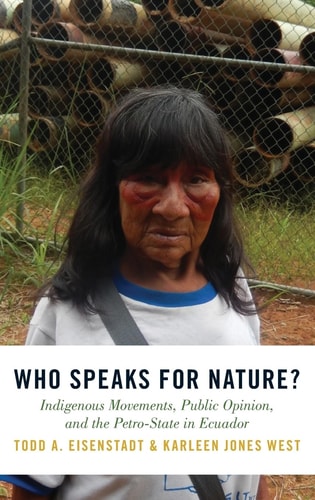
Who Speaks for Nature?: Indigenous Movements, Public Opinion, and the Petro-State in Ecuador
0
0
As an Amazon Associate and affiliate partner, Menrva Books earns from qualifying purchases. Learn more
Author Description
In 2009, Ecuador became the first nation ever to enshrine rights for nature in its constitution. Nature was accorded inalienable rights, and every citizen was granted standing to defend those rights. At the same time, the government advanced a policy of "extractive populism," buying public support for mineral mining by promising that funds from the mining would be used to increase public services.This book, based on a nationwide survey and interviews about environmental attitudes among citizens as well as indigenous, environmental, government, academic, and civil society leaders in Ecuador, offers a theory about when and why individuals will speak for nature, particularly when economic interests are at stake. Parting from conventional social science arguments that political attitudes are determined by ethnicity or social class, the authors argue that environmental dispositions in developing countries are shaped by personal experiences of vulnerability to environmental degradation. Abstract appeals to identity politics, on the other hand, are less effective. Ultimately, this book argues that indigenous groups should be the stewards of nature, but that they must do so by appealing to the concrete, everyday vulnerabilities they face, rather than by turning to the more abstract appeals of ethnic-based movements.
Menrva's Summary
THE THESIS
This book investigates the conditions under which individuals in developing nations prioritize environmental protection over economic gain, specifically within the context of Ecuador's constitutional recognition of nature's rights. Authors Todd A. Eisenstadt and Karleen Jones West utilize a combination of nationwide survey data and qualitative interviews to challenge traditional identity-based political theories. They propose that environmental advocacy is driven more by personal experiences of vulnerability to ecological degradation than by ethnic or class-based affiliations.
THE SCOPE MAP
What You Will Find
- Quantitative analysis of nationwide public opinion surveys regarding environmental attitudes in Ecuador.
- Qualitative insights from interviews with indigenous leaders, government officials, and civil society representatives.
- A theoretical framework linking personal environmental vulnerability to political mobilization.
Scope Limits
- The study focuses primarily on the Ecuadorian context and may not be universally applicable to all developing nations.
- The research does not provide a comprehensive legal history of the 2009 constitution beyond its impact on public discourse.
THE AUTHORITY PERSPECTIVE
Scholars in the fields of comparative politics and environmental studies note the book's contribution to understanding the intersection of extractive populism and grassroots activism. Experts highlight this as a significant text for those examining how environmental policy is shaped by local lived experiences rather than abstract political rhetoric.
Page Count:
288
Publication Date:
2019-04-11
Publisher:
Oxford University Press
ISBN-10:
0190908955
ISBN-13:
9780190908959
South America
Sociology
Politics & Government
Comparative Politics
Energy policy
Public Policy
American Studies
Community Tags
Similar Books