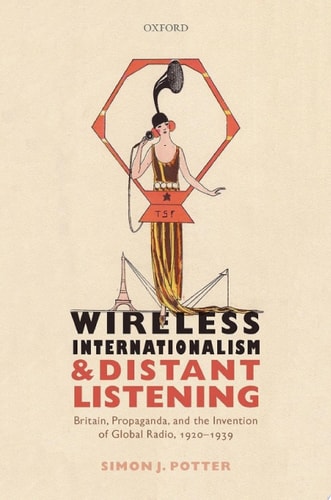
Wireless Internationalism and Distant Listening: Britain, Propaganda, and the Invention of Global Radio, 1920-1939
0
0
As an Amazon Associate and affiliate partner, Menrva Books earns from qualifying purchases. Learn more
Author Description
During the 1920s and 1930s the new medium of radio broadcasting promised to transform society by fostering national unity and strengthening and popularising national cultures. However, many hoped that 'wireless' would also encourage international understanding and world peace. Intentionally or otherwise, wireless signals crossed borders, bringing talk, music, and news to enthusiastic 'distant listeners' in other countries. In Europe, radio was regulated through international consultation and cooperation, to restrict interference between stations, and to unleash the medium's full potential to carry programmes to global audiences. A distinctive form of 'wireless internationalism' emerged, reflecting and reinforcing the broader internationalist movement and establishing structures and approaches which endured into the Second World War, the Cold War, and beyond. This study reveals this untold history. Wireless Internationalism and Distant Listening also explores the neglected interwar experience of distant listening, revealing the prevalence of listening across borders and explaining how individuals struggled to overcome unwanted noise, tune in as many stations as possible, and comprehend and enjoy what they heard. The volume shows how radio brought the world to Britain, and Britain to the world. It revises our understanding of early BBC broadcasting and the BBC Empire Service (the precursor to today's World Service) and shows how government influence shaped early BBC international broadcasting in English, Arabic, Spanish, and Portuguese. It also explores the wider European and trans-Atlantic context, demonstrating how Fascism in Italy and Germany, the Spanish Civil War, and the Japanese invasion of China, combined to overturn the utopianism of the 1920s and usher in a new era of wireless nationalism.
Menrva's Summary
THE THESIS
How did the emergence of radio broadcasting in the interwar period shape the tension between internationalist ideals and the rise of nationalist propaganda? Simon James Potter, a historian specializing in British media and imperial history, examines the development of the BBC Empire Service and the broader European radio landscape to argue that early wireless technology functioned as both a tool for global connection and a weapon for state-sponsored influence.
THE SCOPE MAP
What You Will Find
- Analysis of the BBC Empire Service and its multilingual broadcasts in English, Arabic, Spanish, and Portuguese.
- Examination of the technical and social challenges faced by 'distant listeners' attempting to tune into foreign signals.
- Historical context regarding the shift from 1920s utopianism to the radio nationalism of the 1930s.
Scope Limits
- The study focuses primarily on the British perspective and European/trans-Atlantic contexts, with limited coverage of domestic radio developments outside of their international implications.
THE AUTHORITY PERSPECTIVE
Scholars and historians recognize this work as a significant contribution to the study of early mass media and its role in geopolitical strategy. Readers frequently note the academic density of the prose and the author's meticulous use of archival evidence to reconstruct the interwar listening experience.
Page Count:
256
Publication Date:
2020-01-01
Publisher:
OUP Oxford
ISBN-10:
0192520768
ISBN-13:
9780192520760
History
Media Studies
British History
Radio Broadcasting
Communication
European History
Communication And Traffic
International relations
Propaganda
Community Tags
Similar Books