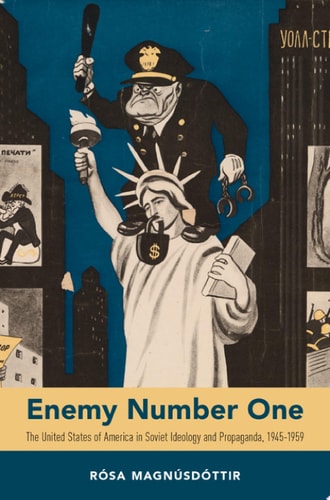
Enemy Number One: The United States of America in Soviet Ideology and Propaganda, 1945-1959
0
0
As an Amazon Associate and affiliate partner, Menrva Books earns from qualifying purchases. Learn more
Author Description
Enemy Number One tells the story of the Soviet cultural and propaganda apparatus and its efforts to control information about the United States in the postwar landscape. Beginning with the 1945 meeting of American and Soviet troops on the Elbe, this period saw cultural relations develop in close connection to oppression as the Soviet authorities attempted to contain and appropriate images of the United States. Rósa Magnúsdóttir analyzes two official narratives about the USSR's "enemy number one" --Stalin's anti-American campaign and Khrushchev's policy of peaceful coexistence--and shows how each relied on the legacy of the wartime alliance in their approach. Stalin used the wartime experience to spread fear of a renewed war, while Khrushchev used the wartime alliance as proof that the two superpowers could work together.Drawing from extensive archival resources, Magnúsdóttir brings to life the propaganda warriors and ideological chiefs of the early Cold War period in the Soviet Union, revealing their confusion and insecurities as they attempted to navigate the uncertain world of late Stalin and early Khrushchev cultural bureaucracy. She also demonstrates how concerned Soviet authorities were by their people's presumed interest in the United States, resorting to monitoring and even repression-behavior indicative of the inferiority complex of the Soviet project as it related to the outside world.
Menrva's Summary
THE THESIS
How did the Soviet state construct and manipulate the image of the United States to maintain ideological control during the early Cold War? Rósa Magnúsdóttir, a historian specializing in Soviet cultural history, utilizes extensive archival research to examine the internal mechanisms of the Soviet propaganda apparatus. She argues that the portrayal of the United States shifted from Stalinist fear-mongering to Khrushchev’s nuanced policy of peaceful coexistence, both of which were deeply rooted in the legacy of the wartime alliance. The text demonstrates that these shifting narratives were driven by the Soviet leadership's profound insecurity regarding their citizens' potential fascination with American culture.
THE SCOPE MAP
What You Will Find
- Analysis of the transition from Stalinist anti-Americanism to Khrushchev’s peaceful coexistence.
- Examination of the Soviet cultural bureaucracy and its internal decision-making processes.
- Investigation into the monitoring and repression of Soviet citizens suspected of harboring pro-American sentiments.
Scope Limits
- The study is strictly confined to the period between 1945 and 1959.
- The book focuses primarily on official state narratives rather than grassroots or dissident perspectives.
THE AUTHORITY PERSPECTIVE
Scholars recognize this work as a detailed examination of the Soviet state's internal anxieties and its efforts to manage public perception. Readers frequently note the academic rigor and the depth of archival evidence provided by the author.
Page Count:
252
Publication Date:
2018-01-01
Publisher:
Oxford University Press
ISBN-10:
0190681489
ISBN-13:
9780190681487
History
Public opinion
European History
Propaganda
Special Topics
United States
Modern History
International relations
Soviet Union
Cold War
Military History
Community Tags
Similar Books