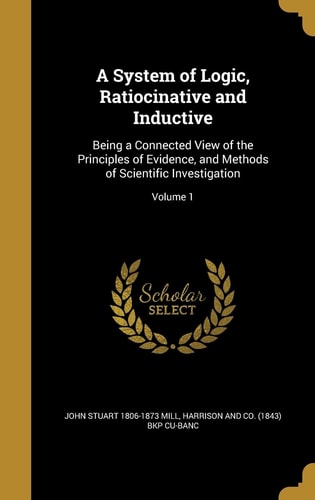
A System of Logic, Ratiocinative and Inductive: Being a Connected View of the Principles of Evidence, and Methods of Scientific Investigation; Volume 1
0
0
As an Amazon Associate and affiliate partner, Menrva Books earns from qualifying purchases. Learn more
Author Description
This work has been selected by scholars as being culturally important, and is part of the knowledge base of civilization as we know it. This work was reproduced from the original artifact, and remains as true to the original work as possible. Therefore, you will see the original copyright references, library stamps (as most of these works have been housed in our most important libraries around the world), and other notations in the work. This work is in the public domain in the United States of America, and possibly other nations. Within the United States, you may freely copy and distribute this work, as no entity (individual or corporate) has a copyright on the body of the work. As a reproduction of a historical artifact, this work may contain missing or blurred pages, poor pictures, errant marks, etc. Scholars believe, and we concur, that this work is important enough to be preserved, reproduced, and made generally available to the public. We appreciate your support of the preservation process, and thank you for being an important part of keeping this knowledge alive and relevant.
Menrva's Summary
THE THESIS
This work investigates the fundamental principles of evidence and the methodologies underpinning scientific investigation. John Stuart Mill, a prominent philosopher and economist, presents a comprehensive exploration of logic, distinguishing between ratiocinative and inductive reasoning. The text aims to provide a connected view of how knowledge is acquired, validated, and expanded, drawing upon historical and philosophical traditions to construct a systematic framework for understanding the nature of proof and the advancement of scientific thought.
THE SCOPE MAP
- Detailed examination of deductive reasoning and its role in establishing certainty.
- In-depth analysis of inductive reasoning, including methods for generalization and causal inference.
- Exploration of the principles of evidence and their application in various fields of inquiry.
- Discussion on the nature of scientific investigation and the logical structures that guide it.
- Consideration of fallacies and errors in reasoning.
- Historical context of logical thought and its development.
- The relationship between language, thought, and logical structure.
THE AUTHORITY PERSPECTIVE
This foundational text is recognized for its significant contribution to the field of logic and epistemology. Scholars acknowledge its enduring importance in shaping the understanding of scientific methodology and the principles of evidence. The work is considered a cornerstone of philosophical inquiry, providing a systematic framework that has influenced subsequent generations of thinkers. Its reproduction ensures its continued availability to students and researchers engaging with the history of thought and the philosophy of science.
Page Count:
600
Publication Date:
2016-08-27
Publisher:
BiblioBazaar
ISBN-10:
1363685244
ISBN-13:
9781363685240
Philosophy
Non-Fiction
Epistemology
Logic
Community Tags
Similar Books