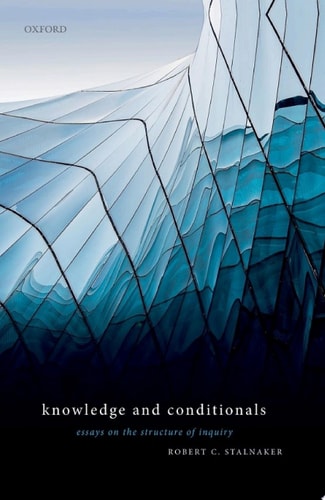
Knowledge and Conditionals: Essays on the Structure of Inquiry
0
0
As an Amazon Associate and affiliate partner, Menrva Books earns from qualifying purchases. Learn more
Author Description
Robert C. Stalnaker presents a set of essays on the structure of inquiry. In the first part he focuses on the concepts of knowledge, belief, and partial belief, and on the rules and procedures we use - or ought to use - to determine what to believe, and what to claim that we know. In the second part he examines conditional statements and conditional beliefs, their role in epistemology, and their relations to causal and explanatory concepts, such as dispositions, objective chance, relations of dependence, and independence. A central concern of the book is the interaction of different cognitive perspectives - the ways in which the attitudes of rational agents are or should be influenced by critical reflection on their present cognitive situation, on their own cognitive situations at other times, and on the cognitive situations of others with whom they interact. The general picture that is developed is naturalistic, following Hume in rejecting a substantive role for pure reason in the defense of inductive rules, and in giving causal concepts a central role in the description and explanation of our cognitive practices. However, Stalnaker rejects the side of Hume that aims to reduce concepts involving natural necessity to more basic descriptive concepts. Instead, he argues that the development of inductive rules and practices takes place in interaction with the development of concepts for giving a theoretical description of the world.
Menrva's Summary
THE THESIS
This collection of essays investigates the structural relationship between human inquiry, the nature of belief, and the logical function of conditional statements. Robert C. Stalnaker, a prominent philosopher of language and mind, utilizes a naturalistic framework to examine how rational agents form, update, and justify their cognitive states. By synthesizing epistemology with causal theory, he argues that our inductive practices are inextricably linked to the conceptual development of our theoretical understanding of the world.
THE SCOPE MAP
What You Will Find
- Analysis of the distinction between knowledge, belief, and partial belief.
- Examination of conditional statements and their role in causal and explanatory reasoning.
- Exploration of cognitive perspectives and the influence of critical reflection on rational agents.
- A naturalistic approach to inductive rules that rejects pure reason as a foundational defense.
Scope Limits
- The text does not provide a comprehensive history of epistemology.
- It does not offer a practical manual for everyday decision-making or psychological self-help.
THE AUTHORITY PERSPECTIVE
Experts recognize this work as a significant contribution to formal epistemology and the philosophy of language. Readers frequently note the technical density of the prose, which is intended for an audience familiar with analytic philosophy and logical notation.
Page Count:
262
Publication Date:
2019-01-01
Publisher:
OUP Oxford
ISBN-10:
0192538306
ISBN-13:
9780192538307
Philosophy
Epistemology
Metaphysics
Knowledge Theory
Conditionals logic
Logic
Community Tags
Similar Books