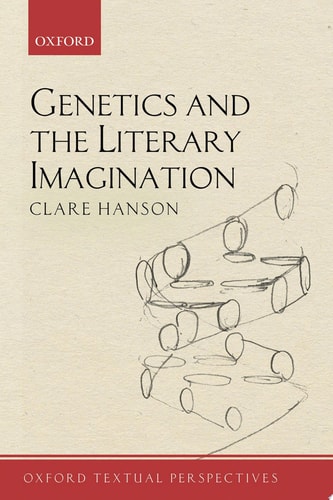
Genetics and the Literary Imagination
0
0
As an Amazon Associate and affiliate partner, Menrva Books earns from qualifying purchases. Learn more
Author Description
Oxford Textual Perspectives is a series of informative and provocative studies focused upon literary texts (conceived of in the broadest sense of that term) and the technologies, cultures, and communities that produce, inform, and receive them. It provides fresh interpretations of fundamental works and of the vital and challenging issues emerging in English literary studies. By engaging with the materiality of the literary text, its production, and reception history, and frequently testing and exploring the boundaries of the notion of text itself, the volumes in the series question familiar frameworks and provide innovative interpretations of both canonical and less well-known works. This is the first book to explore the dramatic impact of genetics on literary fiction over the past four decades. After James Watson and Francis Crick's discovery of the structure of DNA in 1953 and the subsequent cracking of the genetic code, a gene-centric discourse developed which had a major impact not only on biological science but on wider culture. As figures like E. O. Wilson and Richard Dawkins popularised the neo-Darwinian view that behaviour was driven by genetic self-interest, novelists were both compelled and unnerved by such a vision of the origins and ends of life. This book maps the ways in which Doris Lessing, A.S. Byatt, Ian McEwan, and Kazuo Ishiguro wrestled with the reductionist neo-Darwinian account of human nature and with the challenge it posed to humanist beliefs about identity, agency, and morality. It argues that these novelists were alienated to varying degrees by neo-Darwinian arguments but that the recent shift to postgenomic science has enabled a greater rapprochement between biological and (post)humanist concepts of human nature. The postgenomic view of organisms as agentic and interactive is echoed in the life-writing of Margaret Drabble and Jackie Kay, which also explores the ethical implications of this holistic biological perspective.
Menrva's Summary
THE THESIS
This book investigates how the emergence of gene-centric discourse and neo-Darwinian science has fundamentally reshaped the thematic concerns of contemporary literary fiction. Clare Hanson, an expert in the intersection of literature and science, examines how novelists have responded to the reductionist view of human nature popularized by figures like Richard Dawkins. She argues that while early responses were marked by alienation, the transition to postgenomic science has fostered a more nuanced dialogue between biological perspectives and traditional humanist concepts of agency and morality.
THE SCOPE MAP
What You Will Find
- Analysis of literary responses to neo-Darwinian theories from 1953 to the present.
- Examination of works by authors including Doris Lessing, A.S. Byatt, Ian McEwan, and Kazuo Ishiguro.
- Exploration of the shift from gene-centric reductionism to postgenomic holistic biology.
- Discussion of life-writing by Margaret Drabble and Jackie Kay regarding ethical biological perspectives.
Scope Limits
- The analysis focuses primarily on English-language literature and does not provide an exhaustive survey of global literary responses to genetics.
- The text does not serve as a technical manual for genetic science but rather as a cultural critique of its influence on narrative.
THE AUTHORITY PERSPECTIVE
Scholars and critics recognize this work as a significant contribution to the field of literature and science studies. Readers frequently note the academic density of the prose, which provides a rigorous framework for understanding the complex relationship between biological discovery and creative expression.
Page Count:
224
Publication Date:
2020-01-01
Publisher:
OUP Oxford
ISBN-10:
0192542788
ISBN-13:
9780192542786
History
Genetics
Science History
Indigenous
Humanities
Science and Literature
Literary Criticism
Science
Community Tags
Similar Books