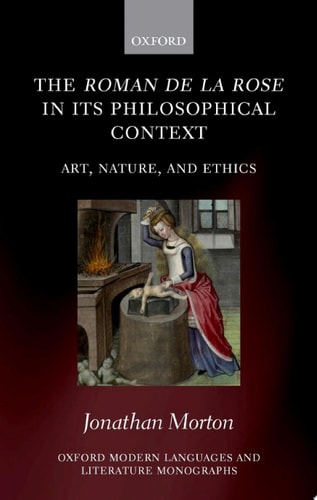
The Roman de la Rose in its Philosophical Context: Art, Nature, and Ethics
0
0
As an Amazon Associate and affiliate partner, Menrva Books earns from qualifying purchases. Learn more
Author Description
The Roman de la rose in its Philosophical Context offers a new interpretation of the long and complex medieval allegorical poem written by Guillaume de Lorris and Jean de Meun in the thirteenth century, a work that became one of the most influential works of vernacular literature in the European Middle Ages. The scope and sophistication of the poem's content, especially in Jean's continuation, has long been acknowledged, but this is the first book-length study to offer an in-depth analysis of how the Rose draws on, and engages with, medieval philosophy, in particular with the Aristotelianism that dominated universities in the thirteenth century. It considers the limitations and possibilities of approaching ideas through the medium of poetic fiction, whose lies paradoxically promise truth and whose ambiguities and self-contradiction make it hard to discern its positions. This indeterminacy allows poetry to investigate the world and the self in ways not available to texts produced in the Scholastic context of universities, especially those of the University of Paris, whose philosophical controversies in the 1270s form the backdrop against which the poem is analysed. At the heart of the Rose are the three ideas of art, nature, and ethics, which cluster around its central subject: love. While the book offers larger claims about the Rose's philosophical agenda, different chapters consider the specifics of how it draws on, and responds to, Roman poetry, twelfth-century Neoplatonism, and thirteenth-century Aristotelianism in broaching questions about desire, epistemology, human nature, the imagination, primitivism, the philosophy of art, and the ethics of money.
Menrva's Summary
THE THESIS
How does the medieval allegorical poem 'The Roman de la rose' engage with and synthesize thirteenth-century Aristotelian philosophy and Scholastic thought? Jonathan Morton, a scholar of medieval literature, utilizes a rigorous analytical framework to examine the poem's complex relationship with the intellectual climate of the University of Paris during the 1270s. By situating the text within its historical and philosophical context, Morton argues that the poem's inherent ambiguity and fictional nature allow it to explore ethical and epistemological questions that were often restricted within formal university discourse.
THE SCOPE MAP
What You Will Find
- Analysis of the intersection between thirteenth-century Aristotelianism and vernacular poetry.
- Examination of the thematic triad of art, nature, and ethics as they relate to the subject of love.
- Investigation into the philosophical implications of poetic fiction versus Scholastic prose.
- Discussion of the influence of twelfth-century Neoplatonism and Roman poetry on the text.
Scope Limits
- The study focuses primarily on the philosophical dimensions of the poem rather than a comprehensive literary or linguistic history.
- The analysis is centered on the specific intellectual controversies of the 1270s rather than the entire reception history of the work.
THE AUTHORITY PERSPECTIVE
Scholars recognize this work as a significant contribution to the study of medieval intellectual history and the intersection of literature and philosophy. Readers frequently note the academic density of the prose, which is intended for specialists in medieval studies and those interested in the philosophical underpinnings of vernacular literature.
Page Count:
214
Publication Date:
2018-01-01
Publisher:
OUP Oxford
ISBN-10:
0192548611
ISBN-13:
9780192548610
Philosophy
History
Poetry
English & College Success
Academic
Literary Criticism
English
In literature