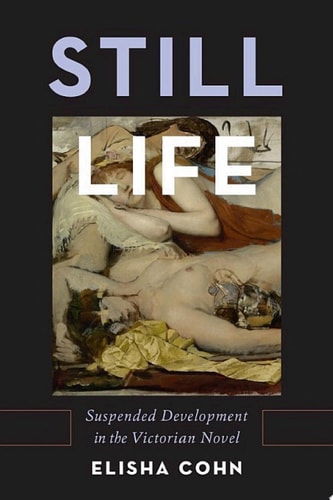
Still Life: Suspended Development in the Victorian Novel
0
0
As an Amazon Associate and affiliate partner, Menrva Books earns from qualifying purchases. Learn more
Author Description
Still Life: Suspended Development in the Victorian Novel rethinks the nineteenth-century aesthetics of agency through the Victorian novel's fascination with states of reverie, trance, and sleep. These states challenge contemporary scientific and philosophical accounts of the perfectibility of the self, which privileged reflective self-awareness. In dialogue with the field of literature and science studies and affect studies, this book shows how Victorian writers used narrative form to respond to the analytical practices and knowledge production of those other disciplines. Drawing upon canonical texts--by Charlotte Brontë, George Eliot, George Meredith, and Thomas Hardy--Still Life contends that depictions of non-purposive perceptual experience suspend the processes of self-cultivation (Bildung) central to Victorian aesthetics, science, psychology, and political theory, as well as most critical accounts of the novel form. Departing from the values of individual cultivation and moral revelation associated with the genre, these writers offer an affective framework for understanding the subtly non-instrumental powers of narrative. Victorian novels ostensibly working within the parameters of the Bildungsroman are suspended by moments of "still life": a decentered lyricism associated with states of diminished consciousness. They use this style to narrate what should be unnarratable: experiences not dependent on reflective consciousness, which express a distinctive ambivalence toward dominant developmental frameworks of individual self-culture.
Menrva's Summary
THE THESIS
This book investigates how Victorian novelists utilized depictions of suspended consciousness—such as trance, reverie, and sleep—to challenge the era's dominant cultural and scientific focus on purposeful self-cultivation. Elisha Cohn, an academic specializing in nineteenth-century literature, argues that these moments of "still life" within the narrative structure disrupt the traditional Bildungsroman, offering an alternative framework for understanding non-instrumental perceptual experience. By analyzing the intersection of literature, psychology, and philosophy, the work posits that these authors intentionally resisted the period's obsession with reflective self-awareness and moral development.
THE SCOPE MAP
What You Will Find
- Analysis of canonical Victorian authors including Charlotte Brontë, George Eliot, George Meredith, and Thomas Hardy.
- A theoretical framework connecting affect studies with literature and science studies.
- Examination of how narrative form functions to represent non-purposive or diminished states of consciousness.
Scope Limits
- The study focuses primarily on the Victorian era and does not extend its analysis to twentieth-century modernist techniques of stream-of-consciousness.
- The book does not provide a comprehensive history of Victorian psychology, but rather focuses on specific literary responses to scientific knowledge production.
THE AUTHORITY PERSPECTIVE
Scholars in the field of Victorian studies recognize this work as a significant contribution to the understanding of narrative aesthetics and the critique of the Bildungsroman. Readers frequently note the academic density of the prose, which is intended for an audience familiar with literary theory and nineteenth-century intellectual history.
Page Count:
272
Publication Date:
2015-01-01
Publisher:
Oxford University Press
ISBN-10:
019049347X
ISBN-13:
9780190493479
English & College Success
Victorian
Affect Studies
In literature
Science History
Academic
English
English fiction
Literary Criticism
Literary theory
Community Tags
Similar Books