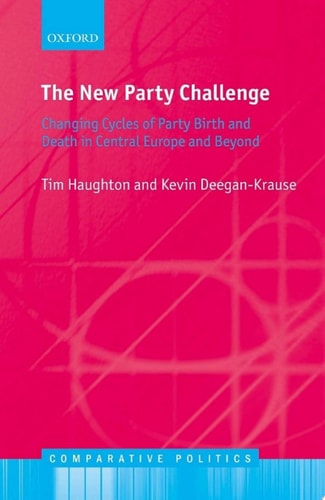
The New Party Challenge: Changing Cycles of Party Birth and Death in Central Europe and Beyond
0
0
As an Amazon Associate and affiliate partner, Menrva Books earns from qualifying purchases. Learn more
Author Description
Why do some parties live fast and die young, but others endure? And why are some party systems more stable than others? Based on a blend of data derived from both qualitative and quantitative sources, The New Party Challenge develops new tools for mapping and measuring party systems, and develops conceptual frameworks to analyse the dynamics of party politics, particularly the birth and death of parties. In addition to highlighting the importance of agency and choice in explaining the fate of parties, the book underlines the salience of the clean versus corrupt dimension of politics, charts the flow of voters in the new party subsystem, and emphasizes the dimension of time and its role in shaping developments. The New Party Challenge not only provides the first systematic book length study of political parties across Central Europe in the three decades since the 1989 revolutions, charting and explaining the patterns of politics in that region, it also highlights that similar processes are at play on a far wider geographical canvas. The book concludes by reflecting on what the dynamics of party politics, especially the emergence of so many new parties, means for the health and quality of democracy, and what could and should be done.
Menrva's Summary
THE THESIS
This book investigates the factors that determine the longevity of political parties and the stability of party systems in Central Europe and beyond. Authors Kevin Deegan-Krause and Tim Haughton utilize a combination of qualitative and quantitative data to construct a framework for analyzing the life cycles of political organizations. They argue that agency, voter behavior, and the specific dimension of clean versus corrupt politics are critical variables in understanding why some parties endure while others collapse.
THE SCOPE MAP
What You Will Find
- A systematic study of political party dynamics across Central Europe since 1989.
- New methodological tools for measuring and mapping party system stability.
- Analysis of the 'clean versus corrupt' political dimension and its impact on voter flow.
Scope Limits
- The analysis focuses primarily on the post-1989 era in Central Europe, though it touches on broader geographical contexts.
- The text does not provide a comprehensive history of every individual party, but rather focuses on systemic patterns of birth and death.
THE AUTHORITY PERSPECTIVE
Experts recognize this work as a foundational study for understanding the volatility of post-communist party systems. Readers frequently note the academic rigor and the clarity of the authors' conceptual frameworks when applied to contemporary democratic challenges.
Page Count:
304
Publication Date:
2020-01-01
Publisher:
OUP Oxford
ISBN-10:
0192542281
ISBN-13:
9780192542281
European History
Democracy
Comparative Politics
Government
Community Tags
Similar Books