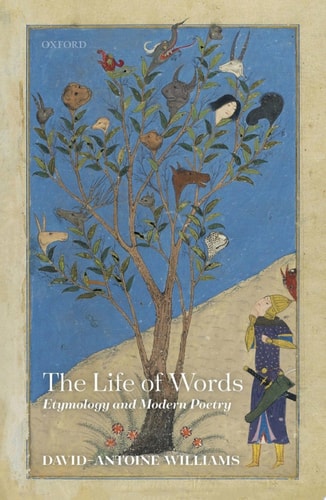
The Life of Words: Etymology and Modern Poetry
0
0
As an Amazon Associate and affiliate partner, Menrva Books earns from qualifying purchases. Learn more
Author Description
For centuries, investigations into the origins of words were entwined with investigations into the origins of humanity and the cosmos. With the development of modern etymological practice in the nineteenth century, however, many cherished etymologies were shown to be impossible, and the very idea of original 'true meaning' asserted in the etymology of 'etymology' declared a fallacy. Structural linguistics later held that the relationship between sound and meaning in language was 'arbitrary', or 'unmotivated', a truth that has survived with small modification until today. On the other hand, the relationship between sound and meaning has been a prime motivator of poems, at all times throughout history. The Life of Words studies a selection of poets inhabiting our 'Age of the Arbitrary', whose auditory-semantic sensibilities have additionally been motivated by a historical sense of the language, troubled as it may be by claims and counterclaims of 'fallacy' or 'true meaning'. Arguing that etymology activates peculiar kinds of epistemology in the modern poem, the book pays extended attention to poems by G. M. Hopkins, Anne Waldman, Ciaran Carson, and Anne Carson, and to the collected works of Geoffrey Hill, Paul Muldoon, Seamus Heaney, R. F. Langley, and J. H. Prynne.
Menrva's Summary
THE THESIS
This book investigates how the practice of etymology functions as a distinct epistemological tool within the context of modern poetry. Author David-Antoine Williams examines the tension between the structuralist view of language as arbitrary and the persistent poetic impulse to derive meaning from word origins. He argues that modern poets utilize etymological inquiry to navigate the historical and semantic complexities of language, effectively challenging the notion that word origins are merely fallacious or irrelevant.
THE SCOPE MAP
What You Will Find
- Analysis of the historical development of etymological practice from the nineteenth century to the present.
- A theoretical framework connecting auditory-semantic sensibilities to historical linguistic awareness.
- Close readings of works by G. M. Hopkins, Anne Waldman, Ciaran Carson, and Anne Carson.
- Comprehensive examination of the collected works of Geoffrey Hill, Paul Muldoon, Seamus Heaney, R. F. Langley, and J. H. Prynne.
Scope Limits
- The study does not provide a general history of etymology outside of its specific application to modern poetic practice.
- It does not attempt to resolve the debate between structural linguistics and historical etymology, but rather observes their intersection in creative writing.
THE AUTHORITY PERSPECTIVE
Scholars and critics recognize this work as a rigorous contribution to the intersection of linguistics and literary studies. Readers frequently note the academic density of the prose, which is intended for an audience familiar with both modern poetry and linguistic theory.
Page Count:
313
Publication Date:
2020-01-01
Publisher:
OUP Oxford
ISBN-10:
0192540556
ISBN-13:
9780192540553
Poetry
Literary Criticism
Academic
Poetry
English poetry
English
Etymology
Linguistics
English & College Success
Community Tags
Similar Books