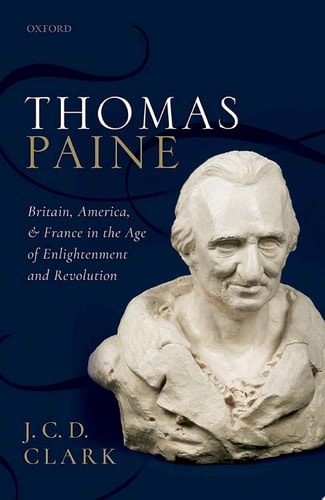
Thomas Paine: Britain, America, and France in the Age of Enlightenment and Revolution
0
0
As an Amazon Associate and affiliate partner, Menrva Books earns from qualifying purchases. Learn more
Author Description
Thomas Paine (1737-1809) was England's greatest revolutionary: no other reformer was as actively involved in events of the scale of the American and French Revolutions, and none wrote such best-selling texts with the impact of Common Sense and Rights of Man. No one else combined the roles of activist and theorist, or did so in the 'age of revolutions', fundamental as it was to the emergence of the 'modern world'. But his fame meant that he was taken up and reinterpreted for current use by successive later commentators and politicians, so that the 'historic Paine' was too often obscured by the 'usable Paine'. J. C. D. Clark explains Paine against a revised background of early- and mid-eighteenth-century England. He argues that Paine knew and learned less about events in America and France than was once thought. He de-attributes a number of publications, and passages, hitherto assumed to have been Paine's own, and detaches him from a number of causes (including anti-slavery, women's emancipation, and class action) with which he was once associated. Paine's formerly obvious association with the early origin and long-term triumph of natural rights, republicanism, and democracy needs to be rethought. As a result, Professor Clark offers a picture of radical and reforming movements as more indebted to the initiatives of large numbers of men and women in fast-evolving situations than to the writings of a few individuals who framed lasting, and eventually triumphant, political discourses.
Menrva's Summary
THE THESIS
This work investigates the historical accuracy of Thomas Paine's influence by questioning the extent to which his writings shaped the American and French Revolutions. J. C. D. Clark, a historian specializing in the eighteenth century, challenges the traditional narrative that positions Paine as a singular, foundational architect of modern democracy. By re-examining the intellectual and political climate of the era, Clark argues that Paine's role has been exaggerated by later commentators who transformed him into a symbolic figurehead for various political causes.
THE SCOPE MAP
What You Will Find
- A critical re-evaluation of Paine's involvement in the American and French Revolutions.
- Analysis of eighteenth-century English political discourse and reform movements.
- Evidence-based de-attribution of specific texts and political stances previously credited to Paine.
Scope Limits
- The text does not provide a comprehensive biography of Paine's personal life.
- It does not focus on the long-term legacy of Paine's ideas in the twentieth or twenty-first centuries.
THE AUTHORITY PERSPECTIVE
Scholars recognize this text as a provocative revisionist study that demands a more nuanced understanding of political agency in the eighteenth century. Readers frequently note the academic density of the prose and the author's rigorous, often controversial, approach to historical attribution.
Page Count:
503
Publication Date:
2018-01-01
Publisher:
OUP Oxford
ISBN-10:
0192548999
ISBN-13:
9780192548993
History
Biography
European History
Enlightenment
18th century
American History
Community Tags
Similar Books