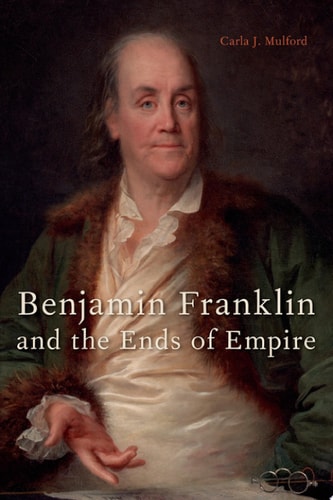
Benjamin Franklin and the Ends of Empire
0
0
As an Amazon Associate and affiliate partner, Menrva Books earns from qualifying purchases. Learn more
Author Description
Drawing from Benjamin Franklin's published and unpublished papers, including letters, notes, and marginalia, Benjamin Franklin and the Ends of Empire examines how the early modern liberalism of Franklin's youthful intellectual life helped foster his vision of independence from Britain that became his hallmark achievement. In the early chapters, Carla Mulford explores the impact of Franklin's family history - especially their difficult times during the English Civil War - on Franklin's intellectual life and his personal and political goals.The book's middle chapters show how Franklin's fascination with British imperial strategy grew from his own analyses of the financial, environmental, and commercial potential of North America. Franklin's involvement in Pennsylvania's politics led him to devise strategies for monetary stability, intercolonial trade, Indian affairs, and imperial defense that would have assisted the British Empire in its effort to take over the world. When Franklin realized that the goals of British ministers were to subordinate colonists in a system that assisted the lives of Britons in England but undermined the wellbeing of North Americans, he began to criticize the goals of British imperialism. Mulford argues that Franklin's turn away from the British Empire began in the 1750s - not the 1770s, as most historians have suggested - and occurred as a result of Franklin's perceptive analyses of what the British Empire was doing not just in the American colonies but in Ireland and India.In the last chapters, Mulford reveals how Franklin ultimately grew restive, formed alliances with French intellectuals and the court of France, and condemned the actions of the British Empire and imperial politicians. As a whole, Mulford's book provides a fresh reading of a much-admired founding father, suggesting how Franklin's conception of the freedoms espoused in England's ages old Magna Carta could be realized in the political life of the new American nation.
Menrva's Summary
THE THESIS
This book investigates how Benjamin Franklin's early intellectual development and his evolving critique of British imperial policy necessitated his shift toward American independence. Carla J. Mulford, a scholar of early American literature and culture, utilizes a comprehensive analysis of Franklin's personal papers, correspondence, and marginalia to challenge traditional timelines regarding his political transformation. She argues that Franklin's disillusionment with the British Empire began as early as the 1750s, rooted in his observations of imperial mismanagement across North America, Ireland, and India.
THE SCOPE MAP
What You Will Find
- Analysis of Franklin's family history and its influence on his political philosophy
- Examination of Franklin's strategies for monetary stability and intercolonial trade
- Comparative study of British imperial actions in North America, Ireland, and India
- Documentation of Franklin's diplomatic shift toward French alliances
Scope Limits
- The text does not provide a comprehensive biography of Franklin's entire life
- It focuses primarily on political and imperial themes rather than personal or domestic details
THE AUTHORITY PERSPECTIVE
Scholars and historians recognize this work as a significant contribution to the study of Franklin's political evolution, particularly for its re-evaluation of his timeline regarding independence. Readers frequently note the academic rigor of the prose and the depth of the archival research presented by the author.
Page Count:
448
Publication Date:
2015-01-01
Publisher:
Oxford University Press
ISBN-10:
0190273186
ISBN-13:
9780190273187
History
Biography
English
Biography Autobiography
English & College Success
18th century
United States
American History
Statesmen biography
Community Tags
Other Editions(3)
Similar Books






Reader Comments
Share Your Thoughts
No comments yet. Be the first to share your thoughts!