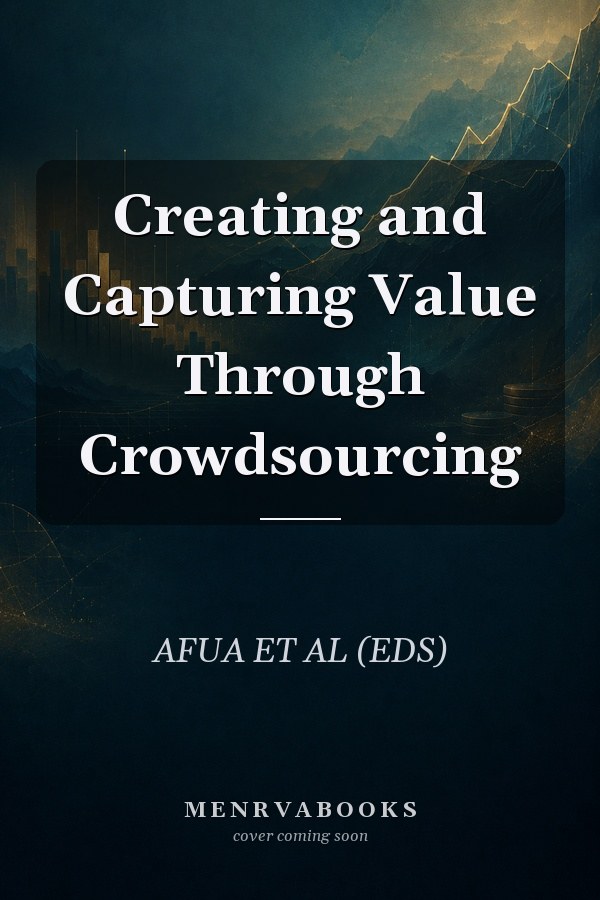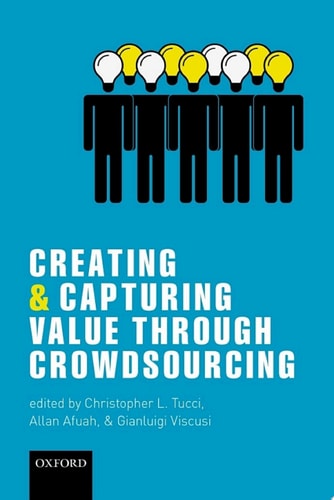
Creating and Capturing Value through Crowdsourcing
0
0
As an Amazon Associate and affiliate partner, Menrva Books earns from qualifying purchases. Learn more
Author Description
Examples of the value that can be created and captured through crowdsourcing go back to at least 1714 when the UK used crowdsourcing to solve the Longitude Problem, obtaining a solution that would enable the UK to become the dominant maritime force of its time. Today, Wikipedia uses crowds to provide entries for the world's largest and free encyclopedia. Partly fueled by the value that can be created and captured through crowdsourcing, interest in researching the phenomenon has been remarkable. Despite this - or perhaps because of it - research into crowdsourcing has been conducted in different research silos, within the fields of management (from strategy to finance to operations to information systems), biology, communications, computer science, economics, political science, among others. In these silos, crowdsourcing takes names such as broadcast search, innovation tournaments, crowdfunding, community innovation, distributed innovation, collective intelligence, open source, crowdpower, and even open innovation. This book aims to assemble chapters from many of these silos, since the ultimate potential of crowdsourcing research is likely to be attained only by bridging them. Chapters provide a systematic overview of the research on crowdsourcing from different fields based on a more encompassing definition of the concept, its difference for innovation, and its value for both private and public sector.
Menrva's Summary
THE THESIS
This book investigates the mechanisms by which crowdsourcing creates and captures value across diverse sectors and academic disciplines. The authors, Allan Afuah, Christopher L. Tucci, and Gianluigi Viscusi, synthesize research from disparate fields including management, computer science, and economics to provide a unified framework. By bridging these research silos, the text aims to establish a comprehensive understanding of how crowdsourcing functions as a tool for innovation in both private and public spheres.
THE SCOPE MAP
What You Will Find
- A systematic overview of crowdsourcing research across multiple academic silos.
- Analysis of crowdsourcing applications ranging from historical examples like the Longitude Problem to modern platforms like Wikipedia.
- Examination of various crowdsourcing models including crowdfunding, broadcast search, and collective intelligence.
Scope Limits
- The text focuses primarily on academic and strategic synthesis rather than providing a tactical 'how-to' guide for individual project implementation.
THE AUTHORITY PERSPECTIVE
Experts recognize this work as a valuable interdisciplinary bridge for scholars and practitioners attempting to navigate the fragmented literature on crowdsourcing. Readers frequently note the academic density of the prose, which serves as a foundational text for those seeking to understand the strategic implications of distributed innovation.
Page Count:
375
Publication Date:
2018-01-01
Publisher:
OUP Oxford
ISBN-10:
0192548204
ISBN-13:
9780192548207
Economics
Business
Management
Strategy
Technology
Innovation
Community Tags
Similar Books