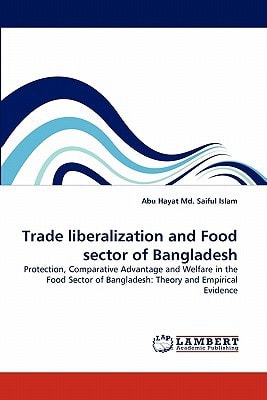
Trade Liberalization and Food Sector of Bangladesh
0
0
As an Amazon Associate and affiliate partner, Menrva Books earns from qualifying purchases. Learn more
Author Description
The book broadly discusses the trade liberalization impact on the food sector of Bangladesh. For doing so the book comprises of two sections, firstly; to analyze the policy incentives in terms of protection and efficiency of production through analysing comparative advantages in the rice sector by using policy analysis matrix (PAM) and secondly, to measure the effect of policy shocks on production, consumption and welfare distribution in the food sector of Bangladesh by using multi market modelling technique. From PAM in-line with financial profit, social profit, policy transfers and various protection coefficients such as NPCO, NPCI, EPC and PC and competitiveness coefficients such as DRC, SCB, SNRL and PNRL were derived.On the other hand, through multimarket modeling five scenarios (baseline: assumed free trade; Doha round: price increased effect;high cost: 5% decrease in supply under highest Doha round projection; productivity shift: 10% increase in supply and national protection: different level of protection in both market under baseline) were analyzed to know the welfare distribution as well as food security impact of price or policy shock
Menrva's Summary
THE THESIS
This book investigates the multifaceted impacts of trade liberalization on Bangladesh's food sector, with a particular focus on rice production and overall food security. The analysis is divided into two core sections: the first employs the Policy Analysis Matrix (PAM) to assess policy incentives, comparative advantages, and production efficiency in the rice sector, deriving key financial, social, and policy-related coefficients. The second section utilizes a multi-market modeling technique to quantify the effects of policy shocks on production, consumption, and welfare distribution across the food sector, examining scenarios such as free trade, Doha Round impacts, and varying levels of national protection.
THE SCOPE MAP
- Analysis of policy incentives and production efficiency in the rice sector using the Policy Analysis Matrix (PAM).
- Derivation of financial profit, social profit, policy transfers, and protection coefficients (NPCO, NPCI, EPC, PC).
- Calculation of competitiveness coefficients including Domestic Resource Cost (DRC), Social Cost-Benefit ratio (SCB), Social Net Benefit Ratio (SNRL), and Private Net Benefit Ratio (PNRL).
- Measurement of the effects of policy shocks on production, consumption, and welfare distribution in the food sector.
- Multi-market modeling to analyze five distinct scenarios: baseline (free trade), Doha Round price increases, high cost (5% supply decrease), productivity shifts (10% supply increase), and national protection levels.
- Assessment of welfare distribution and food security impacts under various price or policy shock conditions.
THE AUTHORITY PERSPECTIVE
The book provides a detailed econometric analysis of trade liberalization's effects on Bangladesh's food sector. Its methodology, employing both the Policy Analysis Matrix and multi-market modeling, suggests a rigorous approach to understanding complex economic interactions. The focus on specific policy scenarios and their welfare implications indicates a contribution to the literature on agricultural economics and development policy in emerging economies. The depth of the analysis points towards a readership interested in empirical economic research and policy evaluation.
Page Count:
144
Publication Date:
2010-10-01
Publisher:
Lap Lambert Academic Publishing GmbH KG
ISBN-10:
3843359407
ISBN-13:
9783843359405
Non-Fiction
Economics
Bangladesh
Trade Policy
Food security
Community Tags
Similar Books