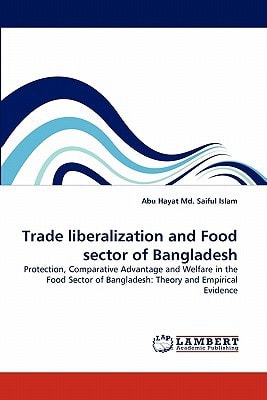
Macroeconomic Situation of Bangladesh: Trade Liberalization, Real Exchange Rate and Export Diversification
0
0
As an Amazon Associate and affiliate partner, Menrva Books earns from qualifying purchases. Learn more
Author Description
There is a wide range of suspicion about the pros and corns of liberalizing the economy, like other developing countries, in Bangladesh, this is still a lively debate. There is no effective ground emphasizing trade liberalization and its impact on economy of Bangladesh. This book focuses on the three important macroeconomic issues: trade liberalization, real exchange rate and export diversification of Bangladesh by evaluating data from 1972 to 2007 through the help of unit root test, cointregation test and error correction method. This book will help the students and researchers to get in-depth knowledge on macroeconomic situation of Bangladesh.
Menrva's Summary
THE THESIS
This book investigates the complex interplay between trade liberalization, the real exchange rate, and export diversification within the context of Bangladesh's economy. The author, Md. Sohag, utilizes extensive data from 1972 to 2007, employing rigorous econometric techniques such as unit root tests, cointegration tests, and the error correction method to analyze these critical macroeconomic issues. The central argument explores the ongoing debate surrounding the benefits and drawbacks of economic liberalization in developing nations, specifically focusing on its impact on Bangladesh's economic landscape and its capacity for export diversification.
THE SCOPE MAP
- Analysis of trade liberalization policies in Bangladesh.
- Examination of the real exchange rate's behavior and its economic implications.
- Investigation into the dynamics of export diversification strategies.
- Application of unit root tests, cointegration tests, and error correction methods.
- Data analysis covering the period from 1972 to 2007.
- Insights for students and researchers on Bangladesh's macroeconomic situation.
THE AUTHORITY PERSPECTIVE
This book offers a data-driven analysis of key macroeconomic factors influencing Bangladesh's economy, providing a valuable resource for academics and students. By employing established econometric tools, it aims to shed light on the contentious issue of trade liberalization and its tangible effects on export diversification. The research presented is likely to appeal to those with a specific interest in the economic development of South Asian nations.
Page Count:
80
Publication Date:
2010-09-28
Publisher:
VDM Verlag Dr. Müller
ISBN-10:
3639298985
ISBN-13:
9783639298987
Non-Fiction
Economics
Trade Policy
Bangladesh
Community Tags
Similar Books