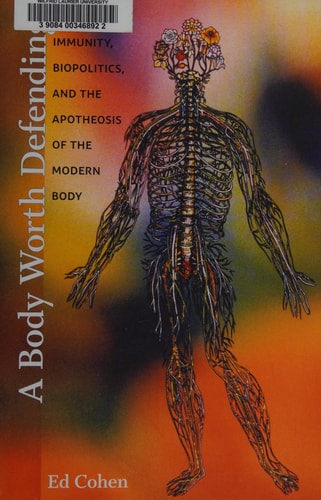
A Body Worth Defending: Immunity, Biopolitics, and the Apotheosis of the Modern Body
0
0
As an Amazon Associate and affiliate partner, Menrva Books earns from qualifying purchases. Learn more
Author Description
Biological immunity as we know it does not exist until the late nineteenth century. Nor does the premise that organisms defend themselves at the cellular or molecular levels. For nearly two thousand years “immunity,” a legal concept invented in ancient Rome, serves almost exclusively political and juridical ends. “Self-defense” also originates in a juridico-political context; it emerges in the mid-seventeenth century, during the English Civil War, when Thomas Hobbes defines it as the first “natural right.” In the 1880s and 1890s, biomedicine fuses these two political precepts into one, creating a new vital function, “immunity-as-defense.” In A Body Worth Defending, Ed Cohen reveals the unacknowledged political, economic, and philosophical assumptions about the human body that biomedicine incorporates when it recruits immunity to safeguard the vulnerable living organism. Inspired by Michel Foucault’s writings about biopolitics and biopower, Cohen traces the migration of immunity from politics and law into the domains of medicine and science. Offering a genealogy of the concept, he illuminates a complex of thinking about modern bodies that percolates through European political, legal, philosophical, economic, governmental, scientific, and medical discourses from the mid-seventeenth century through the twentieth. He shows that by the late nineteenth century, “the body” literally incarnates modern notions of personhood. In this lively cultural rumination, Cohen argues that by embracing the idea of immunity-as-defense so exclusively, biomedicine naturalizes the individual as the privileged focus for identifying and treating illness, thereby devaluing or obscuring approaches to healing situated within communities or collectives.
Menrva's Summary
THE THESIS
This book investigates the historical and conceptual origins of biological immunity and its profound impact on modern understandings of the body. Ed Cohen, drawing inspiration from Michel Foucault's work on biopolitics, traces the evolution of
THE SCOPE MAP
- The historical migration of the concept of immunity from legal and political spheres to medicine and science.
- The fusion of legal concepts of immunity and self-defense into a biological function in the late 19th century.
- An examination of the political, economic, and philosophical assumptions embedded in biomedicine's concept of immunity-as-defense.
- A genealogy of modern notions of personhood as embodied by the late 19th-century concept of the body.
- An argument that the focus on individual immunity devalues community-based approaches to healing.
THE AUTHORITY PERSPECTIVE
Ed Cohen's "A Body Worth Defending" offers a critical examination of how the concept of biological immunity developed, tracing its roots in legal and political thought before its integration into biomedicine. The book's strength lies in its detailed genealogy, revealing the underlying assumptions about the body and personhood that shape modern medical practices. By highlighting the shift from collective to individualistic approaches to health, Cohen provides a nuanced perspective on the historical construction of the 'modern body'. This work is likely to be of significant interest to scholars in the history of medicine, philosophy, and political theory.
Page Count:
384
Publication Date:
2009-10-01
Publisher:
Duke University Press Books
ISBN-10:
0822345358
ISBN-13:
9780822345350
Science & Technology
Philosophy
Health
Non-Fiction
History
Politics
Community Tags
Similar Books














