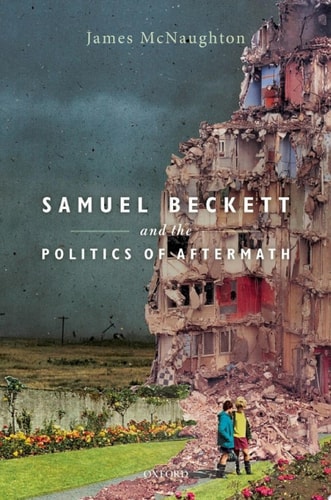
Samuel Beckett and the Politics of Aftermath
0
0
As an Amazon Associate and affiliate partner, Menrva Books earns from qualifying purchases. Learn more
Author Description
Samuel Beckett and the Politics of Aftermath explores Beckett's literary responses to the political maelstroms of his formative and middle years: the Irish civil war and the crisis of commitment in 1930s Europe, the rise of fascism and the atrocities of World War II. Archive yields a Beckett who monitored propaganda in speeches and newspapers, and whose creative work engages with specific political strategies, rhetoric, and events. Finally, Beckett's political aesthetic sharpens into focus. Deep within form, Beckett models ominous historical developments as surely as he satirizes artistic and philosophical interpretations that overlook them. He burdens aesthetic production with guilt: imagination and language, theater and narrative, all parallel political techniques. Beckett comically embodies conservative religious and political doctrines; he plays Irish colonial history against contemporary European horrors; he examines aesthetic complicity in effecting atrocity and covering it up. This book offers insightful, original, and vivid readings of Beckett's work up to Three Novels and Endgame.
Menrva's Summary
THE THESIS
This book investigates how Samuel Beckett’s literary output functions as a direct response to the political crises and historical traumas of the twentieth century. James McNaughton, a scholar of modernism, utilizes archival research to demonstrate that Beckett’s work is not merely abstract or philosophical but deeply engaged with the rhetoric of propaganda, the rise of fascism, and the realities of the Irish civil war. The author argues that Beckett’s aesthetic choices serve as a critique of political complicity and the failure of language to address historical atrocity.
THE SCOPE MAP
What You Will Find
- Analysis of Beckett’s engagement with 1930s European political rhetoric and propaganda.
- Examination of the intersection between Irish colonial history and continental European conflict.
- Critical readings of major works including the Three Novels and Endgame.
Scope Limits
- The analysis focuses primarily on works published up to the period of Endgame and does not provide an exhaustive study of Beckett’s later career.
- The text prioritizes political and historical context over purely formalist or existentialist interpretations of the author's work.
THE AUTHORITY PERSPECTIVE
Scholars and critics recognize this work as a significant contribution to the political re-evaluation of Beckett’s canon. Readers frequently note the academic density of the prose, which provides a rigorous framework for understanding the author's historical consciousness.
Page Count:
236
Publication Date:
2018-01-01
Publisher:
OUP Oxford
ISBN-10:
0192555502
ISBN-13:
9780192555502
Biography
History
Literary Criticism
Ireland
Fascism europe
Indigenous
European
Modernism