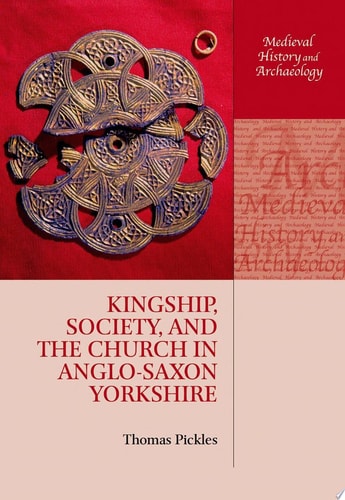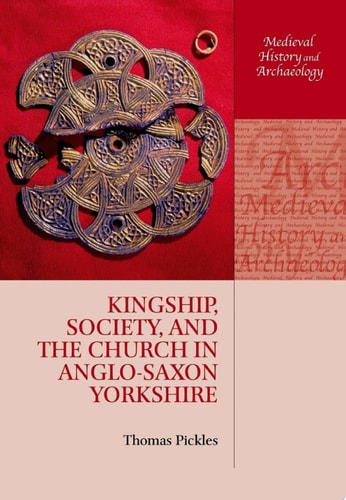
Kingship, Society, and the Church in Anglo-Saxon Yorkshire
0
0
As an Amazon Associate and affiliate partner, Menrva Books earns from qualifying purchases. Learn more
Author Description
Inspired by studies of Carolingian Europe, Kingship, Society and the Church in Anglo-Saxon Yorkshire argues that the social strategies of local kin-groups drove conversion to Christianity and church building in Yorkshire from 400-1066 AD. It challenges the emphasis that has been placed on the role and agency of Anglo-Saxon kings in conversion and church building, and moves forward the debate surrounding the 'minster hypothesis' through an inter-disciplinary case study. Members of Deiran kin-groups faced uncertainties that predisposed them to consider conversion as a social strategy, in their rule between 600 and 867. Their decision to convert produced a new social fraction - the 'ecclesiastical aristocracy' - with a distinctive but fragile identity. The 'ecclesiastical aristocracy' transformed kingship, established a network of religious communities, and engaged in the conversion of the laity. The social and political instabilities produced by conversion along with the fragility of ecclesiastical identity resulted in the expropriation and re-organization of many religious communities. Nevertheless, the Scandinavian and West Saxon kings and their nobles allied with wealthy and influential archbishops of York, and there is evidence for the survival, revival, or foundation of religious communities as well as the establishment of local churches.
Menrva's Summary
THE THESIS
This book investigates whether the conversion to Christianity and the development of church infrastructure in Anglo-Saxon Yorkshire were driven primarily by local kin-group social strategies rather than royal agency. Thomas Pickles utilizes an inter-disciplinary approach, synthesizing historical records and archaeological evidence to challenge the traditional 'minster hypothesis.' By examining the social dynamics of Deiran kin-groups between 600 and 867 AD, the author argues that the emergence of an 'ecclesiastical aristocracy' fundamentally reshaped the political and religious landscape of the region.
THE SCOPE MAP
What You Will Find
- Analysis of social strategies among Deiran kin-groups during the 7th to 9th centuries.
- Examination of the 'minster hypothesis' regarding the distribution of religious communities.
- Investigation into the formation and fragility of the ecclesiastical aristocracy.
- Discussion of the impact of Scandinavian and West Saxon political shifts on church survival.
Scope Limits
- The study is geographically confined to Yorkshire.
- The chronological focus is restricted to the period between 400 and 1066 AD.
THE AUTHORITY PERSPECTIVE
Scholars recognize this work as a significant contribution to the study of regional ecclesiastical development in early medieval England. Readers frequently note the academic density of the prose and the rigorous inter-disciplinary methodology employed to re-evaluate established historical narratives.
Page Count:
412
Publication Date:
2018-01-01
Publisher:
OUP Oxford
ISBN-10:
0192550772
ISBN-13:
9780192550774
History
European History
Church History
Archaeology
Sociology
Christianity And Culture