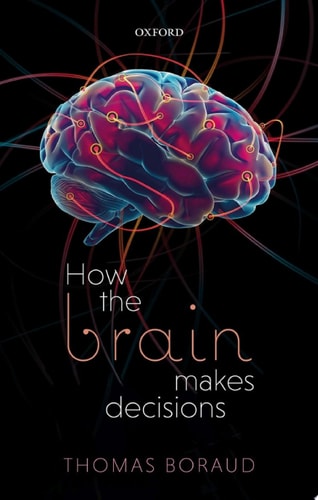
How the Brain Makes Decisions
0
0
As an Amazon Associate and affiliate partner, Menrva Books earns from qualifying purchases. Learn more
Author Description
What if our ability to make decisions was more a matter of chance than a rational process? It has long been recognized that the mind decides, the body obeys. However, as the author of this book argues, in reality it might just be the opposite. The decision-making process is produced by cerebral matter. It is a random phenomenon that results from competing processes within a network whose architecture has changed little since the first vertebrates. This book presents a 'bottom-up' approach to understanding decision making, starting from the fundamental question: what are the basic properties that a neural network of decision making needs to possess? Combining data drawn from phylogeny and physiology, the book provides a general framework for the neurobiology of decision-making in vertebrates, and explains how it evolved from the lamprey to the apes. It also looks at the consequences of such a framework: how it impacts our capacity for reasoning, and considers some aspects of the pathophysiology of higher brain functions. It ends with an open discussion of more philosophical concepts such as the nature of Free-will. Written in a lively and accessible style, the book presents an exciting perspective on understanding decision making.
Menrva's Summary
THE THESIS
This book investigates whether the human decision-making process is a rational, top-down cognitive function or a random phenomenon emerging from competing neural networks. Thomas Boraud, a researcher in neurobiology, utilizes a bottom-up approach to analyze the architecture of neural networks across vertebrate species. By synthesizing data from phylogeny and physiology, he argues that decision-making is a biological process shaped by evolutionary history rather than purely conscious deliberation.
THE SCOPE MAP
What You Will Find
- A comparative analysis of neural network architecture from lampreys to apes.
- A framework for understanding the neurobiology of decision-making in vertebrates.
- An exploration of the pathophysiology of higher brain functions.
- Philosophical discussions regarding the nature of free will.
Scope Limits
- The text does not provide a comprehensive guide to clinical psychology or behavioral therapy.
- It focuses primarily on the biological and evolutionary mechanisms rather than social or cultural influences on choice.
THE AUTHORITY PERSPECTIVE
Experts and readers frequently note that the book successfully bridges the gap between complex neurobiological data and accessible scientific inquiry. The text is recognized for providing a clear, structured framework that remains readable for those without an extensive background in neuroscience.
Page Count:
208
Publication Date:
2020-01-01
Publisher:
OUP Oxford
ISBN-10:
0192557769
ISBN-13:
9780192557766
Psychology
Science
Evolutionary Biology
Biology
Neuroscience
Community Tags
Other Editions(3)

Similar Books