Economics, Politics, and Ethics of Primary Commodity Development: How Can Poor Countries in Africa Benefit the Most?
0
0
As an Amazon Associate and affiliate partner, Menrva Books earns from qualifying purchases. Learn more
Author Description
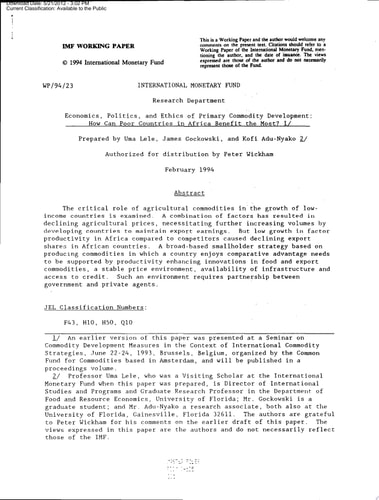
The critical role of agricultural commodities in the growth of low-income countries is examined. A combination of factors has resulted in declining agricultural prices, necessitating further increasing volumes by developing countries to maintain export earnings. But low growth in factor productivity in Africa compared to competitors caused declining export shares in African countries. A broad-based smallholder strategy based on producing commodities in which a country enjoys comparative advantage needs to be supported by productivity enhancing innovations in food and export commodities, a stable price environment, availability of infrastructure and access to credit. Such an environment requires partnership between government and private agents.
Menrva's Summary
THE THESIS
This book investigates how primary commodity development can best benefit low-income African countries amidst declining global prices and productivity challenges. It examines the critical role of agricultural commodities in economic growth, detailing how a combination of factors has led to falling prices, forcing developing nations to increase export volumes to maintain earnings. However, Africa's low growth in factor productivity compared to competitors has resulted in declining export shares. The authors propose a broad-based smallholder strategy focused on commodities where a country holds a comparative advantage, supported by productivity-enhancing innovations, stable prices, infrastructure, and credit access, necessitating government and private sector partnerships.
THE SCOPE MAP
- Analysis of the role of agricultural commodities in the economic growth of low-income countries.
- Examination of factors contributing to declining agricultural prices and their impact on export earnings.
- Comparative analysis of factor productivity growth in Africa versus competitor nations.
- Discussion of a broad-based smallholder strategy for commodity production.
- Exploration of productivity-enhancing innovations in food and export commodities.
- Assessment of the need for a stable price environment, infrastructure, and access to credit.
- Emphasis on the required partnership between government and private agents for development.
THE AUTHORITY PERSPECTIVE
The book addresses the complex interplay of economics, politics, and ethics in primary commodity development within Africa. It highlights the challenges faced by low-income countries due to declining commodity prices and productivity issues, proposing a strategic approach to maximize benefits. The analysis emphasizes the need for innovation, infrastructure, and collaborative efforts between governments and private entities to foster sustainable growth. The work is positioned as a critical examination of development strategies for African nations reliant on commodity exports.
Page Count:
36
Publication Date:
1994-02-01
Publisher:
International Monetary Fund
ISBN-10:
145192108X
ISBN-13:
9781451921083
Politics
Economics
Non-Fiction
Ethics
Agriculture
Community Tags
Similar Books