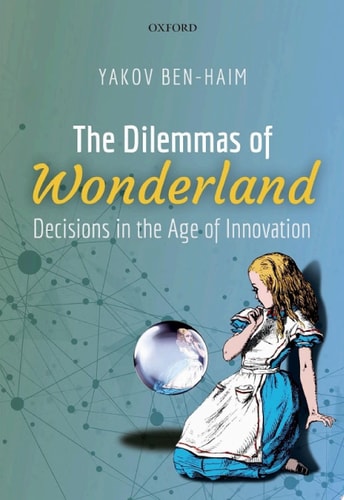
The Dilemmas of Wonderland: Decisions in the Age of Innovation
0
0
As an Amazon Associate and affiliate partner, Menrva Books earns from qualifying purchases. Learn more
Author Description
Innovations create both opportunities and dilemmas. They provide new and supposedly better opportunities, but -- because of their newness -- they are often more uncertain and potentially worse than existing options. Recent inventions and discoveries include new drugs, new energy sources, new foods, new manufacturing technologies, new toys and new pedagogical methods, new weapon systems, new home appliances and many other discoveries and inventions. Is it better to use or not to use a new and promising but unfamiliar and hence uncertain innovation? That dilemma faces just about everybody. The paradigm of the innovation dilemma characterizes many situations, even when a new technology is not actually involved. The dilemma arises from new attitudes, like individual responsibility for the global environment, or new social conceptions, like global allegiance and self-identity transcending nation-states. These dilemmas have far-reaching implications for individuals, organizations, and society at large as they make decisions in the age of innovation. The uncritical belief in outcome-optimization -- "more is better, so most is best" -- pervades decision-making in all domains, but is often irresponsible when facing the uncertainties of innovation. There is a great need for practical conceptual tools for understanding and managing the dilemmas of innovation. This book offers a new direction for a wide audience. It discusses examples from many fields, including e-reading, bipolar disorder and pregnancy, disruptive technology in industry, stock markets, agricultural productivity and world hunger, military hardware, military intelligence, biological conservation, on-line learning, and more.
Menrva's Summary
THE THESIS
This book investigates the core question of how individuals and organizations can effectively navigate the inherent uncertainties and risks associated with adopting new innovations. Author Yakov Ben-Haim, an expert in decision-making under uncertainty, challenges the prevailing paradigm of outcome-optimization. He argues that the uncritical pursuit of 'more' is often irresponsible, proposing instead a framework for managing the dilemmas posed by new technologies, social attitudes, and global shifts.
THE SCOPE MAP
What You Will Find
- A conceptual framework for decision-making under deep uncertainty.
- Analysis of diverse sectors including healthcare, military intelligence, agriculture, and finance.
- Critique of traditional optimization models in the face of unknown outcomes.
Scope Limits
- The text does not provide a singular, universal algorithm for every specific industry.
- It does not focus on the technical engineering of the innovations themselves, but rather the decision-making process surrounding their adoption.
THE AUTHORITY PERSPECTIVE
Experts recognize this work as a significant contribution to the field of decision theory, particularly for its focus on robustness over optimization. Readers frequently note the academic density of the prose, which is best suited for those interested in formal decision-making frameworks and risk management strategies.
Page Count:
163
Publication Date:
2018-01-01
Publisher:
OUP Oxford
ISBN-10:
0192555405
ISBN-13:
9780192555403
Non-Fiction
Philosophy
Decision Making
Technology
Innovation
Technology & Engineering
Sociology
Trades & Technology