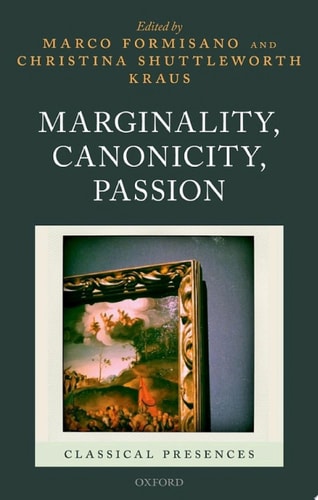
Marginality, Canonicity, Passion
0
0
As an Amazon Associate and affiliate partner, Menrva Books earns from qualifying purchases. Learn more
Author Description
In Recent Years, The Discipline Of Classics Has Been Experiencing A Profound Transformation Affecting Not Only Its Methodologies And Hermeneutic Practices - How Classicists Read And Interpret Ancient Literature - But Also, And More Importantly, The Objects Of Classical Study Themselves. One Of The Most Important Factors Has Been The Establishment Of Reception Studies, Examining The Ways In Which Classical Literature And Culture Have Been Appropriated Or Responded To In Later Ages And/or Non-western Cultures. This Temporal And Cultural Expansion Beyond The 'traditional' Remit Of The Field Has Had Many Salutary Effects, But Reception Studies Are Not Without Limitations: Of Particular Consequence Is A Tendency To Focus Almost Exclusively On The Most Canonical Greek And Latin Texts Which Is Partly Due To The Sheer Scale On Which They Have Been Received, Adapted, Discussed, And Alluded To Since Antiquity. By Definition, Reception Studies Are Uninterested In Texts Which Have Had No 'success', But The Result Of An Implicit Adoption Of Canonicity As An Unspoken Criterion Is The Marginalization Of Other Texts Which, Despite Their Inherent Value, Have Not Experienced So Significant A Nachleben. This Volume Seeks To Move Beyond The Questions Of What Is Central, What Is Marginal, And Why, To Explore Instead The Range And Significance Of The Classical Canon And The Processes By Which It Is Shaped And Changed By Its Reception In Different Academic And Cultural Environments. By Examining The Academic Study Of Classics From The Interrelated Titular Perspectives Of Marginality, Canonicity, And Passion, It Aims To Unveil Their Many Subtle Implications And Reopen A Discussion Not Only About What Makes The Discipline Unique, But Also About What Direction It Might Take In The Future.
Menrva's Summary
THE THESIS
This volume investigates how the implicit reliance on canonicity within the field of Classics marginalizes non-canonical texts and seeks to redefine the criteria by which classical literature is valued and studied. Editors Christina Shuttleworth Kraus and Marco Formisano assemble a collection of scholarly essays that challenge the traditional focus on widely received texts. By analyzing the intersection of marginality, canonicity, and the intellectual passion driving academic inquiry, the authors propose a framework for expanding the scope of classical studies beyond established hierarchies. The work serves as a critical intervention in contemporary hermeneutic practices and the evolution of the discipline.
THE SCOPE MAP
What You Will Find
- Theoretical analysis of the mechanisms behind canon formation in classical studies
- Case studies examining the reception of non-canonical versus canonical Greek and Latin texts
- Methodological critiques of current reception studies practices
- Explorations of how cultural and academic environments influence literary value
Scope Limits
- The volume does not provide a comprehensive history of all classical texts
- It does not offer a definitive list of new canonical works to replace the old
THE AUTHORITY PERSPECTIVE
Scholars and students of Classics frequently cite this work as a significant contribution to the ongoing debate regarding the future of the discipline. Experts highlight the text as a rigorous examination of the biases inherent in reception studies and a necessary prompt for re-evaluating academic priorities.
Page Count:
416
Publication Date:
2018-01-01
Publisher:
Oxford University Press
ISBN-10:
0192550535
ISBN-13:
9780192550538
Classics
Reception Studies
Cultural History
Academic
Literary Criticism