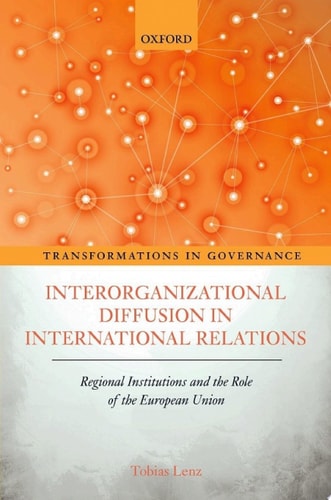
Interorganizational Diffusion in International Relations: Regional Institutions and the Role of the European Union
0
0
As an Amazon Associate and affiliate partner, Menrva Books earns from qualifying purchases. Learn more
Author Description
This is an open access title available under the terms of a CC BY-NC-ND 4.0 International licence. It is free to read at Oxford Scholarship Online and offered as a free PDF download from OUP and selected open access locations. How and under what conditions does the European Union (EU) shape processes of institution building in other regional organizations? Interorganizational Diffusion in International Relations: Regional Institutions and the Role of the European Union develops and tests a theory of interorganizational diffusion in international relations that explains how successful pioneer organizations shape institutional choices in other organizations by affecting the institutional preferences and bargaining strategies of national governments. The author argues that Europe's foremost regional organization systematically affects institution building abroad, but that such influence varies across different types of organizations. Mixing quantitative and qualitative methods, it shows how the EU institutionally strengthens regional organizations through active engagement and by building its own institutions at home. Yet, the contractual nature of other regional organizations bounds this causal influence; EU influence makes a distinguishable difference primarily in those organizations that, like the EU itself, rest on an open-ended contract. Evidence for these claims is drawn from the statistical analysis of a dataset on the institutionalization of 35 regional organizations in the period from 1950 to 2017 as well as detailed single and comparative case studies on institutional creation and change in the Southern African Development Community, Mercosur, the Association of Southeast Asian Nations, and the North American Free Trade Agreement. Transformations in Governance is a major academic book series from Oxford University Press. It is designed to accommodate the impressive growth of research in comparative politics, international relations, public policy, federalism,
Menrva's Summary
THE THESIS
How and under what conditions does the European Union (EU) shape processes of institution building in other regional organizations? Tobias Lenz, a scholar specializing in international organizations, develops a theory of interorganizational diffusion to explain how successful pioneer organizations influence the institutional choices of other regional bodies. By analyzing how the EU affects the preferences and bargaining strategies of national governments, the author provides a framework for understanding the mechanisms of institutional transfer in global politics.
THE SCOPE MAP
What You Will Find
- A theoretical model of interorganizational diffusion based on institutional preferences and bargaining strategies.
- Statistical analysis of a dataset covering the institutionalization of 35 regional organizations from 1950 to 2017.
- Comparative case studies of the Southern African Development Community, Mercosur, the Association of Southeast Asian Nations, and the North American Free Trade Agreement.
Scope Limits
- The study focuses primarily on the influence of the EU and does not extensively analyze the internal dynamics of non-regional international organizations.
- The analysis is bounded by the contractual nature of the target organizations, specifically focusing on those with open-ended contracts.
THE AUTHORITY PERSPECTIVE
Experts in international relations recognize this work as a rigorous contribution to the study of regionalism and institutional diffusion. Readers frequently note the academic density of the prose and the systematic integration of quantitative data with qualitative case studies.
Page Count:
275
Publication Date:
2021-01-01
Publisher:
OUP Oxford
ISBN-10:
0192557130
ISBN-13:
9780192557131
Institutional Theory
Comparative Politics
European Union
Governance
International relations
Community Tags
Other Editions(2)
Similar Books















Reader Comments
Share Your Thoughts
No comments yet. Be the first to share your thoughts!