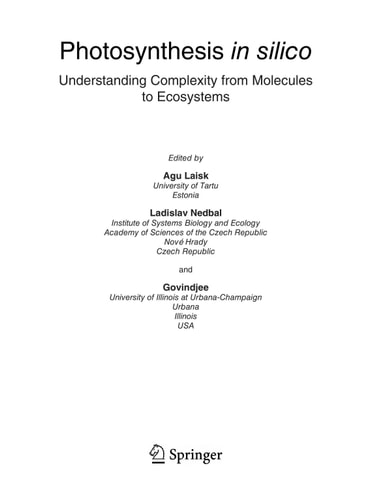
Photosynthesis in silico
0
0
As an Amazon Associate and affiliate partner, Menrva Books earns from qualifying purchases. Learn more
Author Description
Photosynthesis in silico: Understanding Complexity from Molecules to Ecosystems is a unique book that aims to show an integrated approach to the understanding of photosynthesis processes. In this volume - using mathematical modeling - processes are described from the biophysics of the interaction of light with pigment systems to the mutual interaction of individual plants and other organisms in canopies and large ecosystems, up to the global ecosystem issues. Chapters are written by 44 international authorities from 15 countries. Mathematics is a powerful tool for quantitative analysis. Properly programmed, contemporary computers are able to mimic complicated processes in living cells, leaves, canopies and ecosystems. These simulations - mathematical models - help us predict the photosynthetic responses of modeled systems under various combinations of environmental conditions, potentially occurring in nature, e.g., the responses of plant canopies to globally increasing temperature and atmospheric CO2 concentration. Tremendous analytical power is needed to understand nature's infinite complexity at every level.
Menrva's Summary
THE THESIS
This book investigates the complex phenomenon of photosynthesis by integrating mathematical modeling across multiple scales, from molecular interactions to global ecosystems. The authors, including renowned experts Agu Laisk, Govindjee, and Ladislav Nedbal, present a comprehensive approach to understanding photosynthesis. Utilizing contemporary computer simulations, the book explores how these models can predict plant responses to environmental changes, such as rising temperatures and CO2 concentrations. The work is structured around contributions from 44 international authorities, offering a diverse perspective on quantitative analysis in biological systems.
THE SCOPE MAP
- Mathematical modeling of light interaction with pigment systems.
- Biophysics of photosynthesis at the molecular level.
- Modeling of plant and ecosystem interactions.
- Analysis of photosynthetic responses to environmental conditions (temperature, CO2).
- Global ecosystem implications of photosynthesis.
- Contributions from 44 international authorities across 15 countries.
- Application of quantitative analysis to biological complexity.
THE AUTHORITY PERSPECTIVE
The book is presented as a unique volume offering an integrated approach to understanding photosynthesis through mathematical modeling. Its scope spans from the biophysics of light interaction with pigment systems to the dynamics of plants within ecosystems and global environmental issues. The work emphasizes the power of quantitative analysis and contemporary computer simulations to predict photosynthetic responses to changing environmental conditions, such as increasing temperature and atmospheric CO2 concentration. Chapters are authored by 44 international experts, providing a broad and deep exploration of the subject.
Page Count:
503
Publication Date:
2009-06-19
Publisher:
Springer Nature
ISBN-10:
1402092377
ISBN-13:
9781402092374
Science
Non-Fiction
Computer Modeling
Biology
Ecology
Community Tags
Similar Books