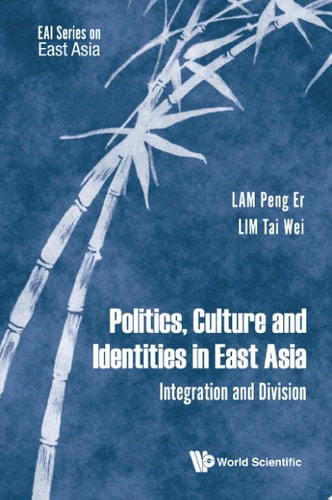
Politics, Culture and Identities in East Asia: Integration and Division
0
0
As an Amazon Associate and affiliate partner, Menrva Books earns from qualifying purchases. Learn more
Author Description
This edited book reflects the "yin-yang" of East Asia — the analogy of co-existing "hot and cold" trends in that region. To concentrate only on geopolitical competition and regional "hot spots" will exaggerate, if not misrepresent East Asia as a Hobbesian world. Nevertheless, geopolitical competition cannot be ignored because a failure of the balance of power and deterrence between China and the United States (and its allies) will destabilise the region. There are four "vectors" in the geopolitics of East Asia: China rising, the United States "rebalancing" to this region, Japan "normalising" as a nation-state and ASEAN emerging as a regional community. The interplay of these four "vectors" will set the trajectory of geopolitics in East Asia. Another focus of this volume is on the politics of identity. The distinctiveness, character and flavour of a group, real or imagined, can be "cool". "Cool" as in being charming and appealing transcends national boundaries. Plurality and diversity of identities and cultures in East Asia can be a celebration of life and humanity. However, xenophobic identities, often based on exclusive race, language, religion and hegemony, and its subsequent politicisation can rend a nation apart. Indeed, the affirmation of one's identity may be at the expense or denial of the identity of "the other". Similarly, the assertion and the intricacy of identity and nationalism in East Asia can also be problematic. However, a person or group can have multiple and different scales of identities. Indeed, identities can be fluid and situational.
Menrva's Summary
THE THESIS
This edited volume examines the dualistic nature of East Asia, exploring both the forces of integration and division that shape its political and cultural landscape. The book posits that focusing solely on geopolitical competition risks misrepresenting the region as a purely conflict-driven environment. However, it acknowledges the critical role of power dynamics, particularly between China and the United States, in maintaining regional stability. The analysis is structured around four key geopolitical vectors: China's rise, the US's strategic rebalancing, Japan's evolving national identity, and ASEAN's development as a regional community. Alongside geopolitical analysis, the volume delves into the complex politics of identity, distinguishing between appealing, cross-border identities and divisive, xenophobic ones that can destabilize nations.
THE SCOPE MAP
- Introduction: Politics, Culture and Identity in East Asia: Integration and Division
- Four Geopolitical Vectors in East Asia: China Rising, US Rebalancing, Japan "Normalising" and ASEAN Community Building
- Analysis of "hot spots" in the Korean Peninsula
- Exploration of the interplay between geopolitical competition and regional economic interdependence
- Discussion on the nature of identity politics in East Asia, including both unifying and divisive aspects
- Examination of how cultural distinctiveness and diversity can be sources of appeal and integration
- Analysis of the politicization of xenophobic identities based on race, language, and religion
- Consideration of the fluidity and multiplicity of identities in the East Asian context
THE AUTHORITY PERSPECTIVE
The book presents a nuanced perspective on East Asia, using the 'yin-yang' analogy to capture the region's coexisting trends of integration and division. It balances the discussion of geopolitical rivalries with an exploration of cultural identities, suggesting that both are crucial for understanding the region's trajectory. The analysis of the four geopolitical vectors provides a framework for comprehending current power dynamics. Furthermore, the examination of identity politics highlights its potential for both fostering appeal and creating societal rifts. The volume aims to offer a comprehensive view that moves beyond a singular focus on conflict.
Page Count:
144
Publication Date:
2017-09-15
Publisher:
World Scientific Publishing Company
ISBN-10:
9813226242
ISBN-13:
9789813226241
Non-Fiction
Politics
History
Geopolitics
Asian Studies
International relations
Community Tags
Similar Books