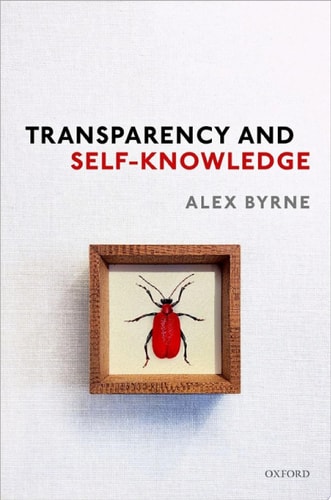
Transparency and Self-Knowledge
0
0
As an Amazon Associate and affiliate partner, Menrva Books earns from qualifying purchases. Learn more
Author Description
Alex Byrne sets out and defends a theory of self-knowledge-knowledge of one's mental states. Inspired by Gareth Evans' discussion of self-knowledge in his The Varieties of Reference, the basic idea is that one comes to know that one is in a mental state M by an inference from a worldly or environmental premise to the conclusion that one is in M. (Typically the worldly premise will not be about anything mental.) The mind, on this account, is 'transparent': self-knowledge is achieved by an 'outward glance' at the corresponding tract of the world, not by an 'inward glance' at one's own mind. Belief is the clearest case, with the inference being from 'p' to 'I believe that p'. One serious problem with this idea is that the inference seems terrible, because 'p' is at best very weak evidence that one believes that p. Another is that the idea seems not to generalize. For example, what is the worldly premise corresponding to 'I intend to do this', or 'I feel a pain'? Byrne argues that both problems can be solved, and explains how the account covers perception, sensation, desire, intention, emotion, memory, imagination, and thought. The result is a unified theory of self-knowledge that explains the epistemic security of beliefs about one's mental states (privileged access), as well as the fact that one has a special first-person way of knowing about one's mental states (peculiar access).
Menrva's Summary
THE THESIS
How can an individual possess direct, privileged knowledge of their own mental states without relying on an introspective 'inward glance'? Alex Byrne proposes a theory of transparency, arguing that self-knowledge is achieved through an outward-facing inference from environmental or worldly premises. By building upon the work of Gareth Evans, Byrne constructs a unified framework that accounts for the epistemic security and unique first-person access individuals have regarding their own internal states.
THE SCOPE MAP
What You Will Find
- A systematic defense of the transparency thesis applied to various mental states.
- An analysis of the inferential structure linking worldly facts to mental state attribution.
- Application of the theory to perception, sensation, desire, intention, emotion, memory, imagination, and thought.
Scope Limits
- The text does not provide an exhaustive survey of historical introspective theories.
- The work focuses primarily on analytic philosophical arguments rather than empirical psychological data.
THE AUTHORITY PERSPECTIVE
Experts recognize this work as a significant contribution to contemporary debates regarding self-knowledge and the nature of mental access. Readers frequently note the academic density of the prose, which requires a strong background in analytic philosophy to fully navigate the proposed inferential models.
Page Count:
239
Publication Date:
2018-01-01
Publisher:
OUP Oxford
ISBN-10:
0192554743
ISBN-13:
9780192554741
Philosophy
Epistemology
Mind & Body
Metaphysics
Philosophy of
Community Tags
Similar Books