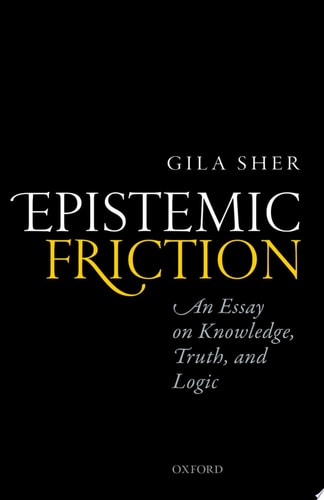
Epistemic Friction: An Essay on Knowledge, Truth, and Logic
0
0
As an Amazon Associate and affiliate partner, Menrva Books earns from qualifying purchases. Learn more
Author Description
Gila Sher approaches knowledge from the perspective of the basic human epistemic situation--the situation of limited yet resourceful beings, living in a complex world and aspiring to know it in its full complexity. What principles should guide them? Two fundamental principles of knowledge are epistemic friction and freedom. Knowledge must be substantially constrained by the world (friction), but without active participation of the knower in accessing the world (freedom) theoretical knowledge is impossible. This requires a grounding of all knowledge, empirical and abstract, in both mind and world, but the fall of traditional foundationalism has led many to doubt the viability of this 'classical' project. The book challenges this skepticism, charting a new foundational methodology, foundational holism, that differs from others in being holistic, world-oriented, and universal (i.e., applicable to all fields of knowledge). Using this methodology, Epistemic Friction develops an integrated theory of knowledge, truth, and logic. This includes (i) a dynamic model of knowledge, incorporating some of Quine's revolutionary ideas while rejecting his narrow empiricism, (ii) a substantivist, non-traditional correspondence theory of truth, and (iii) an outline of a joint grounding of logic in mind and world. The model of knowledge subjects all disciplines to robust norms of both veridicality and conceptualization. The correspondence theory is at once robust, universal, and flexible, allowing multiple patterns of correspondence, including complex and indirect patterns. Logic's systematic grounding brings it in line with other disciplines without neglecting its strong necessity, generality, and normativity, which are explained by its semantic formality.
Menrva's Summary
THE THESIS
How can human beings, as limited yet resourceful agents, achieve a robust and reliable understanding of a complex world? Gila Sher, a prominent philosopher of logic and language, addresses this by proposing a new foundational methodology termed foundational holism. She argues that knowledge requires a balance between epistemic friction—the constraints imposed by the world—and epistemic freedom—the active role of the human mind in conceptualization. By rejecting traditional foundationalism while avoiding the pitfalls of narrow empiricism, Sher constructs an integrated framework that bridges the gap between mind and world across all disciplines.
THE SCOPE MAP
What You Will Find
- A comprehensive model of knowledge that incorporates dynamic, holistic, and world-oriented principles.
- A substantivist, non-traditional correspondence theory of truth that allows for indirect and complex patterns.
- A systematic grounding of logic that accounts for its necessity, generality, and normativity through semantic formality.
- A critical engagement with Quinean empiricism and the history of foundationalist thought.
Scope Limits
- The text does not provide a historical survey of all epistemological theories, focusing instead on the development of the author's specific foundational holism.
- It does not offer a practical guide for empirical scientific research, remaining strictly within the domain of theoretical philosophy.
THE AUTHORITY PERSPECTIVE
Experts recognize this work as a significant contribution to contemporary epistemology and the philosophy of logic. Readers frequently note the academic density of the prose, which requires a strong background in analytic philosophy to fully grasp the nuances of Sher's proposed methodology.
Page Count:
320
Publication Date:
2016-01-01
Publisher:
OUP Oxford
ISBN-10:
0191081299
ISBN-13:
9780191081293
Philosophy
Truth
Metaphysics
Epistemology
Logic
Philosophy of
Knowledge Theory
Community Tags
Similar Books