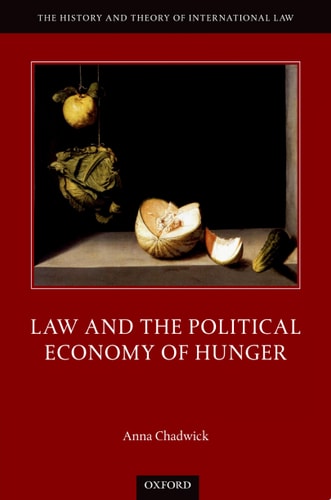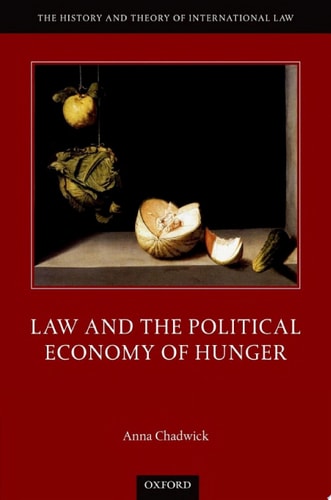
Law and the Political Economy of Hunger: The History and Theory of International Law
0
0
As an Amazon Associate and affiliate partner, Menrva Books earns from qualifying purchases. Learn more
Author Description
This book is an inquiry into the role of law in the contemporary political economy of hunger. In the work of many international institutions, governments, and NGOs, law is represented as a solution to the persistence of hunger. This presentation is evident in the efforts to realize a human right to adequate food, as well as in the positioning of law, in the form of regulation, as a tool to protect society from 'unruly' markets. In this monograph, Anna Chadwick draws on theoretical work from a range of disciplines to challenge accounts that portray law's role in the context of hunger as exclusively remedial. The book takes as its starting point claims that financial traders 'caused' the 2007-8 global food crisis by speculating in financial instruments linked to the prices of staple grains. The introduction of new regulations to curb the 'excesses' of the financial sector in order to protect the food insecure reinforces the dominant perception that law can solve the problem. Chadwick investigates a number of different legal regimes spanning public international law, international economic law, transnational governance, private law, and human rights law to gather evidence for a counterclaim: law is part of the problem. The character of the contemporary global food system-a food system that is being progressively 'financialized'-owes everything to law. If world hunger is to be eradicated, Chadwick argues, then greater attention needs to be paid to how different legal regimes operate to consistently privilege the interests of the wealthy few over the needs of poor and the hungry.
Menrva's Summary
THE THESIS
This book investigates the role of law in the contemporary political economy of hunger, challenging the prevailing notion that legal frameworks serve primarily as a remedy for food insecurity. Anna Chadwick, a scholar in international law and political economy, utilizes a multidisciplinary theoretical approach to examine how legal regimes contribute to the structural causes of hunger. By analyzing the financialization of the global food system, she argues that law often functions to protect the interests of the wealthy rather than the food insecure.
THE SCOPE MAP
What You Will Find
- Analysis of the 2007-8 global food crisis and financial speculation in staple grains.
- Examination of public international law, international economic law, and private law.
- Critique of human rights law as a tool for addressing food insecurity.
Scope Limits
- The text does not provide a comprehensive history of global agricultural policy.
- It does not offer a prescriptive policy manual for immediate legislative reform.
THE AUTHORITY PERSPECTIVE
Scholars in international law and political economy identify this work as a critical intervention in the discourse surrounding global food systems. Readers frequently note the academic density of the prose and the rigorous interdisciplinary methodology employed by the author.
Page Count:
247
Publication Date:
2019-01-01
Publisher:
OUP Oxford
ISBN-10:
019255722X
ISBN-13:
9780192557223
Economics
Law
International relations
Human rights
Professional Career & Trade
Food security
Community Tags
Similar Books