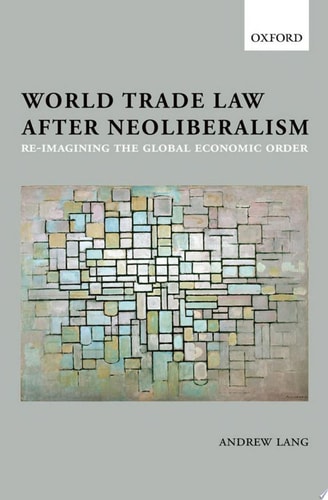
World Trade Law After Neoliberalism
0
0
As an Amazon Associate and affiliate partner, Menrva Books earns from qualifying purchases. Learn more
Author Description
The Rise Of Economic Liberalism In The Latter Stages Of The 20th Century Coincided With A Fundamental Transformation Of International Economic Governance, Especially Through The Law Of The World Trade Organization. In This Book, Andrew Lang Provides A New Account Of This Transformation, And Considers Its Enduring Implications For International Law. Against The Commonly-held Idea That 'neoliberal' Policy Prescriptions Were Encoded Into Wto Law, Lang Argues That The Last Decades Of The 20th Century Saw A Reinvention Of The International Trade Regime, And A Reconstitution Of Its Internal Structures Of Knowledge. In Addition, The Book Explores The Way That Resistance To Economic Liberalism Was Expressed And Articulated Over The Same Period In Other Areas Of International Law, Most Prominently International Human Rights Law. It Considers The Promise And Limitations Of This Form Of 'inter-regime' Contestation, Arguing That Measures To Ensure Greater Collaboration And Cooperation Between Regimes May Fail In Their Objectives If They Are Not Accompanied By A Simultaneous Destabilization Of Each Regime's Structures Of Knowledge And Characteristic Features. With That In Mind, The Book Contributes To A Full And Productive Contestation Of The Nature And Purpose Of Global Economic Governance.
Menrva's Summary
THE THESIS
This book investigates how the international trade regime was fundamentally transformed during the late 20th century and what these shifts imply for the future of global economic governance. Andrew Lang, a scholar of international law, challenges the prevailing narrative that neoliberal policies were simply hard-coded into World Trade Organization (WTO) law. Instead, he presents a framework that views this era as a period of institutional reinvention and a reconstitution of the internal structures of knowledge that govern international trade.
THE SCOPE MAP
What You Will Find
- An analysis of the evolution of international economic governance from the late 20th century to the present.
- A comparative study of trade law and international human rights law.
- A critique of current inter-regime collaboration efforts.
Scope Limits
- The text does not provide a comprehensive history of every WTO dispute settlement case.
- It does not offer a prescriptive policy manual for future trade negotiations.
THE AUTHORITY PERSPECTIVE
Legal scholars and political economists frequently cite this work for its sophisticated critique of institutional knowledge structures within international law. Experts highlight the text as a significant contribution to the debate on how different international legal regimes interact and potentially conflict with one another.
Page Count:
416
Publication Date:
2013-01-01
Publisher:
Oup Oxford
ISBN-10:
0191656143
ISBN-13:
9780191656149
Economics
World Trade Organization
International Law
Globalization
Human rights