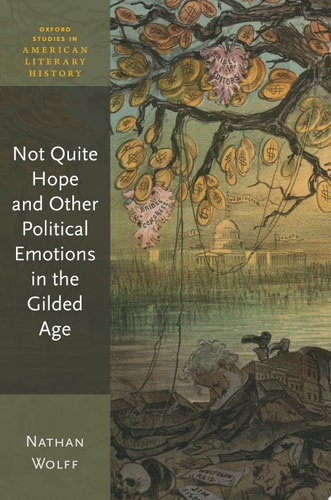
Not Quite Hope and Other Political Emotions in the Gilded Age
Author Description
Not Quite Hope and Other Political Emotions in the Gilded Age argues that late nineteenth-century US fiction grapples with and helps to conceptualize the disagreeable feelings that are both a threat to citizens' agency and an inescapable part of the emotional life of democracy—then as now. In detailing the corruption and venality for which the period remains known, authors including Mark Twain, Harriet Beecher Stowe, Henry Adams, and Helen Hunt Jackson evoked the depressing inefficacy of reform, the lunatic passions of the mob, and the revolting appetites of lobbyists and office seekers. Readers and critics of these Washington novels, historical romances, and satiric romans à clef have denounced these books' fiercely negative tone, seeing it as a sign of cynicism and elitism. Not Quite Hope argues, in contrast, that their distrust of politics is coupled with an intense investment in it: not quite apathy, but not quite hope. Chapters examine both common and idiosyncratic forms of political emotion, including 'crazy love', disgust, cynicism, 'election fatigue', and the myriad feelings of hatred and suspicion provoked by the figure of the hypocrite. In so doing, the book corrects critics' too-narrow focus on 'sympathy' as the American novel's model political emotion. We think of reform novels as fostering feeling for fellow citizens or for specific causes. This volume argues that Gilded Age fiction refocuses attention on the unstable emotions that continue to shape our relation to politics as such.
Menrva's Summary
THE THESIS
This book investigates how late nineteenth-century American fiction conceptualizes the disagreeable political emotions that challenge democratic agency. Nathan Wolff, a scholar of American literature, examines how authors of the Gilded Age utilized negative affects to navigate the corruption and political instability of their era. By analyzing works from writers like Mark Twain and Henry Adams, the author argues that these texts demonstrate a complex, intense investment in politics that exists between apathy and optimism.
THE SCOPE MAP
What You Will Find
- Analysis of political emotions including disgust, cynicism, and election fatigue.
- Examination of canonical Gilded Age genres such as Washington novels, historical romances, and romans à clef.
- A critical reassessment of the role of sympathy in the American novel.
Scope Limits
- The study focuses primarily on late nineteenth-century US fiction and does not provide a comprehensive history of Gilded Age political institutions.
- It does not attempt to offer a prescriptive guide for modern political engagement.
THE AUTHORITY PERSPECTIVE
Scholars recognize this work as a significant intervention in the study of affect theory and American literary history. Experts highlight the text for its ability to challenge traditional critical focus on sympathy, offering a nuanced perspective on the emotional complexities of democratic participation.
Page Count:
256
Publication Date:
2018-01-01
Publisher:
Oxford University Press
ISBN-10:
0192567527
ISBN-13:
9780192567529
American History
Literary Criticism
American
Gilded Age
Community Tags
Similar Books