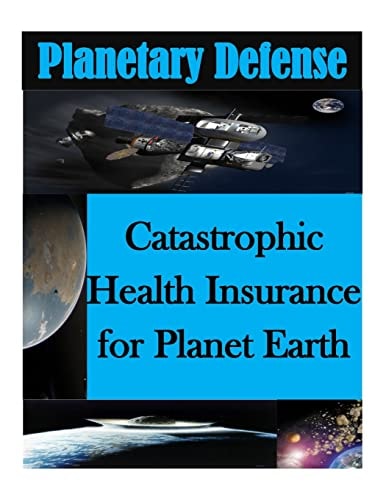
Catastrophic Health Insurance for Planet Earth
0
0
As an Amazon Associate and affiliate partner, Menrva Books earns from qualifying purchases. Learn more
Author Description
Concern exists among an increasing number of scientists throughout the world regarding the possibility of a catastrophic event caused by an impact of a large earth-crossing object (ECO) on the Earth-Moon System (EMS), be it an asteroid or comet. Such events, although rare for large objects (greater than 1 kilometer diameter), are not unprecedented. Indeed, the great upheaval and resulting ice age that marked the extinction of the dinosaurs is thought to have been caused by the impact of a 10 km diameter asteroid. In 1908 a stonyasteroid of approximately 50 meters diameter exploded in the air above the Tunguska River in Siberia, producing an equivalent yield of 15-30 megatons of TNT, and leveling over 2,000 square miles of dense forest. Such an event is thought to occur approximately every century. It is only a matter of time before the world finds itself in a crisis situation-a crisis involving the detection of a large ECO, leaving little time to react and resulting in global panic, chaos, and possible catastrophe.Collectively as a global community, no current viable capability exists to defend the EMS against a large ECO, leaving its inhabitants vulnerable to possible death and destruction of untold proportion and even possible extinction of the human race. In this regard, a planetary defense system (PDS) capability should be resourced, developed, and deployed. At this time Planetary Defense is not an assigned or approved mission of the Department of Defense or the Air Force. Such a system would consist of a detection subsystem, command, control, communications, computer, and intelligence (C4I) subsystem and a mitigation subsystem. There are many potential variations of these subsystems which, with advances in novel technologies, will be available by 2025 to develop a credible PDS. We propose a three-tier system developed sequentially in time and space. Such a system would serve not only as a means to preserve life on earth, but also help to unite the global commun
Menrva's Summary
THE THESIS
The potential for a catastrophic asteroid or comet impact poses an existential threat to humanity, yet no global defense system currently exists. The description highlights the scientific concern over large Earth-crossing objects (ECOs), citing the dinosaur extinction event and the 1908 Tunguska event as evidence of their destructive power. It argues that a coordinated global community lacks the capability to defend the Earth-Moon System, necessitating the development of a Planetary Defense System (PDS) comprising detection, command, control, communications, computer, and intelligence (C4I), and mitigation subsystems. The text suggests that advances in technology by 2025 could enable a credible PDS, proposing a sequential, three-tier system to preserve life and unite the global community.
THE SCOPE MAP
- Analysis of the threat posed by large Earth-crossing objects (asteroids and comets).
- Historical examples of impact events, including the dinosaur extinction and the Tunguska event.
- Assessment of the current global lack of a viable defense system against ECOs.
- Proposal for a Planetary Defense System (PDS) with detection, C4I, and mitigation subsystems.
- Discussion of technological advancements expected by 2025 for PDS development.
- Outline of a sequential, three-tier PDS strategy.
- The argument for PDS as a means to preserve human life and foster global unity.
THE AUTHORITY PERSPECTIVE
The text presents a clear and urgent argument for the necessity of a global planetary defense system. It outlines the scientific basis for concern regarding asteroid and comet impacts, drawing on historical events to underscore the potential for catastrophe. The author(s) from the Air Command and Staff College advocate for a structured, technologically-driven approach to defense, emphasizing the current void in global preparedness and the potential for such a system to unite humanity.
Page Count:
76
Publication Date:
2014-06-05
Publisher:
CreateSpace Independent Publishing Platform
ISBN-10:
1499786999
ISBN-13:
9781499786996
Non-Fiction
Science
Community Tags
Similar Books