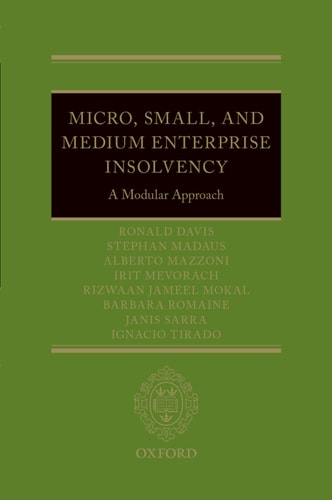
Micro, Small, and Medium Enterprise Insolvency: A Modular Approach
0
0
As an Amazon Associate and affiliate partner, Menrva Books earns from qualifying purchases. Learn more
Author Description
This new book systematically examines the current process for distressed Micro, Small and Medium Enterprises (MSMEs), and proposes a different, more appropriate, 'modular' approach to the treatment of such entities when faced with insolvency proceedings. MSMEs play a vital role in virtually all global economies. They are a primary means by which entrepreneurs bring new business propositions to the market, and deliver a range of products and services to local economies. MSMEs tend to be more reliant on favourable legal and regulatory climates to survive and thrive than larger businesses, and insolvency regimes are often more tailored to these larger businesses, assuming an extensive insolvency estate of significant worth, and the presence of creditors and other concerned stakeholders to participate in and oversee the process. These assumptions and features are generally incongruous with the reality of MSMEs, for whom assets are of less value and whose stakeholders are generally more disinterested. The modular approach proposed in this book addresses the imbalances, inconsistencies, and lack of supervision which is often apparent in treatment of insolvent MSMEs. It provides an overview of existing approaches to MSME insolvency, the place of MSMEs in the global economy, and the particular needs of MSMEs in financial distress. It then sets out the procedural framework, policy objectives, and key components of the modular approach, detailing how a choice of modules enables national policy-makers a more flexible process for resolution. It then outlines the roles, positions, and obligations of key stakeholder groups, and explains the managerial, administrative, and judicial functions of this approach. Finally, it explains how elements of the broader legal system should be aligned with, and supportive of, the optimal functioning of the modular approach.
Menrva's Summary
THE THESIS
This book investigates how current insolvency regimes fail to address the unique economic realities of Micro, Small, and Medium Enterprises (MSMEs) and proposes a flexible, modular framework for their resolution. The authors, a distinguished group of legal scholars and jurists, synthesize global economic data and comparative legal analysis to argue that traditional insolvency procedures are ill-suited for smaller entities. They present a policy-oriented framework that allows national legislators to select specific modules tailored to the scale and stakeholder dynamics of MSMEs, thereby improving efficiency and economic recovery.
THE SCOPE MAP
What You Will Find
- A comprehensive analysis of the role of MSMEs in the global economy.
- A detailed procedural framework for modular insolvency resolution.
- Definitions of roles and obligations for creditors, managers, and judicial actors.
- Policy objectives for aligning broader legal systems with MSME-specific needs.
Scope Limits
- The text does not provide a single, universal law but rather a menu of options for national policy-makers.
- It does not focus on the insolvency of large-scale multinational corporations or complex financial institutions.
THE AUTHORITY PERSPECTIVE
Experts in international commercial law recognize this work as a significant contribution to the discourse on SME-specific insolvency reform. Readers frequently note the academic density of the prose, which serves as a rigorous resource for policy-makers and legal practitioners seeking to modernize their national frameworks.
Page Count:
246
Publication Date:
2018-01-01
Publisher:
OUP Oxford
ISBN-10:
0192560034
ISBN-13:
9780192560032
Economics
Business
Professional Career & Trade
Public Policy
Insolvency
Corporate governance
Law
Community Tags
Similar Books







Reader Comments
Share Your Thoughts
No comments yet. Be the first to share your thoughts!