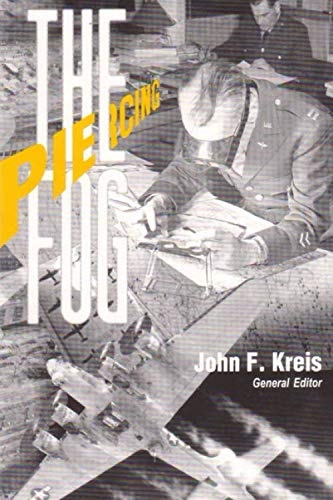
Piercing the Fog: Intelligence and Army Air Forces Operations in World War II
0
0
As an Amazon Associate and affiliate partner, Menrva Books earns from qualifying purchases. Learn more
Author Description
When Japan attacked Pearl Harbor on December 7,1941, and Germany and Italy joined Japan four days later in declaring war against the United States, intelligence essential for the Army Air Forces to conduct effective warfare in the European and Pacific theaters did not exist. Piercing the Fog tells the intriguing story of how airmen built intelligence organizations to collect and process information about the enemy and to produce and disseminate intelligence to decision makers and warfighters in the bloody, horrific crucible of war. Because the problems confronting and confounding air intelligence officers, planners, and operators fifty years ago still resonate, Piercing the Fog is particularly valuable for intelligence officers, planners, and operators today and for anyone concerned with acquiring and exploiting intelligence for successful air warfare. More than organizational history, this book reveals the indispensable and necessarily secret role intelligence plays in effectively waging war. It examines how World War II was a watershed period for Air Force Intelligence and for the acquisition and use of signals intelligence, photo reconnaissance intelligence, human resources intelligence, and scientific and technical intelligence.Piercing the Fog discusses the development of new sources and methods of intelligence collection; requirements for intelligence at the strategic, operational, and tactical levels of warfare; intelligence to support missions for air superiority, interdiction, strategic bombardment, and air defense; the sharing of intelligence in a coalition and joint service environment; the acquisition of intelligence to assess bomb damage on a target-by-target basis and to measure progress in achieving campaign and war objectives; and the ability of military leaders to understand the intentions and capabilities of the enemy and to appreciate the pressures on intelligence officers to sometimes tell commanders what they think the commanders want to hear in
Menrva's Summary
THE THESIS
This book investigates the critical, yet often clandestine, development of intelligence capabilities within the Army Air Forces during World War II. It details how airmen established and refined organizations to gather, process, and disseminate enemy information, a function that was virtually non-existent at the war's outset. The narrative explores the challenges faced by intelligence officers in producing actionable intelligence for decision-makers and combat units across the European and Pacific theaters, highlighting the indispensable role of intelligence in successful air warfare.
THE SCOPE MAP
- The evolution of air intelligence organizations from their inception to wartime effectiveness.
- Analysis of various intelligence disciplines: signals intelligence, photo reconnaissance, human intelligence, and scientific/technical intelligence.
- The development of new methods and sources for intelligence collection.
- Requirements for intelligence at strategic, operational, and tactical levels.
- Intelligence support for specific air missions like air superiority, interdiction, and strategic bombardment.
- Challenges and practices of intelligence sharing in coalition and joint service environments.
- The role of intelligence in assessing campaign progress and enemy capabilities.
THE AUTHORITY PERSPECTIVE
The book is presented as a valuable resource for contemporary intelligence professionals, planners, and operators due to the enduring relevance of the challenges faced by their World War II predecessors. It is noted for revealing the essential and secret nature of intelligence in warfare, marking World War II as a pivotal era for Air Force Intelligence. The work examines the acquisition and application of diverse intelligence types, underscoring its significance for understanding successful air warfare.
Page Count:
515
Publication Date:
2019-09-04
Publisher:
Independently Published
ISBN-10:
1690913029
ISBN-13:
9781690913023
History
Non-Fiction
Military History
Community Tags
Similar Books





Reader Comments
Share Your Thoughts
No comments yet. Be the first to share your thoughts!