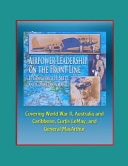
Airpower Leadership on the Front Line: Lt Gen George H. Brett and Combat Command
0
0
As an Amazon Associate and affiliate partner, Menrva Books earns from qualifying purchases. Learn more
Author Description
With Airpower Leadership on the Front Line: Lt Gen George H. Brett and Combat Command, Douglas Cox makes a singular contribution to American airpower biography. Books abound on personalities that reach high rank and whose careers culminate in great success. These studies often glean keen insight about leadership style, and some are vocationally valuable as examples of effective command. But the analysis of history's great winners yields something less than a full dimensional sense of leadership. The examination of those men and women who do not quite reach exalted status can flesh out the lessons of effective leadership. This is what Cox does here. George H. Brett certainly reached high rank, and only the most cynical and uninformed observer would judge his career a failure. Yet World War II did not propel him along the same career trajectory of a Curtis LeMay or a Hoyt Vandenberg or a Jimmy Doolittle. Why? For all kinds of reasons; some of which were good, some bad, some within Brett's control, and others entirely outside his purview. Through a careful examination of primary and secondary sources, as well as his own acumen as a sharp officer, Cox uses Brett's life to illuminate those factors that at first sped Brett through the ranks and then those variables that appeared to block his further advancement. Cox reminds us of what we often know intuitively but often forget intellectually: that success has many fathers, including personal luck and fortuitous circumstance. Airpower Leadership on the Front Line pulls no punches regarding Brett's limitations, but it also acknowledges broader factors at play in his career. In the end, Cox delineates those factors that make for successful leaders; and, more importantly, suggests which among those variables are within a person's control and hence worthy of attention and energy. As much as studies of commanders who grabbed the brass ring, this examination of George H. Brett adds insight into the makings of effective leadershipi
Menrva's Summary
THE THESIS
This book examines the leadership of Lt. Gen. George H. Brett during World War II, exploring the factors that influenced his career trajectory. Douglas Cox's analysis uses Brett's life as a lens to understand the multifaceted nature of leadership, contrasting his career with those of more famously successful contemporaries like Curtis LeMay. The study investigates both Brett's personal attributes and external circumstances, such as luck and timing, that contributed to his advancement and eventual limitations in command. Ultimately, the book aims to delineate the components of effective leadership, distinguishing between controllable and uncontrollable variables.
THE SCOPE MAP
- An in-depth biographical study of Lt. Gen. George H. Brett.
- Analysis of combat command during World War II, focusing on Australia and the Caribbean.
- Comparative leadership study with figures like Curtis LeMay and General MacArthur.
- Exploration of factors influencing career advancement and limitations in military leadership.
- Examination of the roles of personal attributes, luck, and circumstance in leadership success.
- Insights into the makings of effective leadership, distinguishing controllable elements.
THE AUTHORITY PERSPECTIVE
The book is presented as a singular contribution to airpower biography, offering a nuanced perspective on leadership by examining a figure who achieved high rank but did not reach the absolute pinnacle of success. By analyzing Lt. Gen. George H. Brett's career, the author, Douglas Cox, aims to provide a more complete understanding of leadership than studies focusing solely on universally acclaimed commanders. The work is noted for its candid assessment of Brett's limitations alongside broader contextual factors, suggesting that success is influenced by a combination of personal qualities and fortuitous circumstances. The analysis seeks to identify controllable variables that contribute to effective leadership, making it valuable for understanding command dynamics.
Page Count:
79
Publication Date:
2018-03-03
Publisher:
Amazon Digital Services LLC - KDP Print US
ISBN-10:
1980459797
ISBN-13:
9781980459798
Non-Fiction
History
Biography
Military History
Community Tags
Similar Books









Reader Comments
Share Your Thoughts
No comments yet. Be the first to share your thoughts!