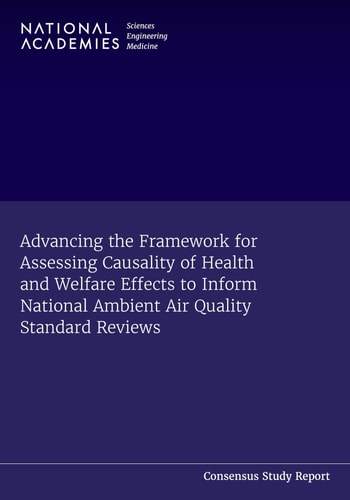
Advancing the Framework for Assessing Causality of Health and Welfare Effects to Inform National Ambient Air Quality Standard Reviews
0
0
As an Amazon Associate and affiliate partner, Menrva Books earns from qualifying purchases. Learn more
Author Description
As part of its responsibilities under the Clean Air Act, the U.S. Environmental Protection Agency sets National Ambient Air Quality Standards (NAAQS) for the air pollutants carbon monoxide, lead, oxides of nitrogen, particulate matter, ozone, and sulfur dioxide. EPA uses a "weight of evidence approach" to evaluate evidence from scientific studies and describe the causal relationships between these "criteria pollutants" and any adverse impacts on human health and on public welfare - including impacts on wildlife, water, forests, agriculture, and climate. The evaluation, called an Integrated Science Assessment, is used to inform standards setting associated with the criteria pollutants. This report, produced at the request of EPA, describes EPAs and several other frameworks for inferring causality of health or welfare effects and the characteristics of evidence useful for forming a causal determination. The report concludes that EPAs causal framework is effective, reliable, and scientifically defensible, provided that key scientific questions are identified and a range of necessary expertise is engaged. More transparency in how EPA integrates evidence could improve confidence in their determinations, and more guidance is needed in the framework on how evidence should be examined for vulnerable groups (e.g., human sub-populations) and sensitive ecosystems or species.
Menrva's Summary
THE THESIS
This report assesses the frameworks used to determine causal relationships between air pollutants and their health and environmental impacts. The U.S. Environmental Protection Agency (EPA) sets National Ambient Air Quality Standards (NAAQS) for six criteria pollutants, relying on a
THE SCOPE MAP
- An examination of EPA's and other frameworks for inferring causality of health or welfare effects.
- An analysis of the characteristics of evidence useful for forming a causal determination.
- An evaluation of EPA's causal framework, concluding it is effective, reliable, and scientifically defensible.
- Recommendations for improving transparency in EPA's evidence integration.
- Guidance needed for examining evidence related to vulnerable groups and sensitive ecosystems.
THE AUTHORITY PERSPECTIVE
This report is regarded as a thorough and scientifically sound evaluation of existing frameworks for assessing the causality of health and welfare effects from air pollution. It affirms the effectiveness of the EPA's current approach while highlighting areas for enhancement, particularly concerning transparency and the consideration of vulnerable populations and ecosystems. The consensus among the involved scientific bodies is that the EPA's framework is robust when key scientific questions are addressed and multidisciplinary expertise is engaged. The report's conclusions are intended to inform and strengthen the scientific basis for National Ambient Air Quality Standard reviews.
Page Count:
186
Publication Date:
2023-01-21
Publisher:
National Academies Press
ISBN-10:
0309690110
ISBN-13:
9780309690119
Science
Health
Non-Fiction
Science & Technology
Public Health
Policy
Community Tags
Similar Books











Reader Comments
Share Your Thoughts
No comments yet. Be the first to share your thoughts!