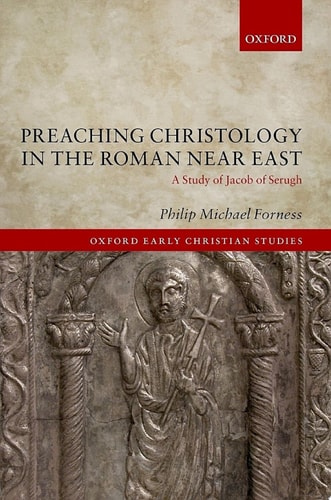
Preaching Christology in the Roman Near East: A Study of Jacob of Serugh
0
0
As an Amazon Associate and affiliate partner, Menrva Books earns from qualifying purchases. Learn more
Author Description
Preaching formed one of the primary, regular avenues of communication between ecclesiastical elites and a wide range of society. Clergy used homilies to spread knowledge of complex theological debates prevalent in late antique Christian discourse. Some sermons even offer glimpses into the locations in which communities gathered to hear orators preach. Although homilies survive in greater number than most other types of literature, most do not specify the setting of their initial delivery, dating, and authorship. Preaching Christology in the Roman Near East addresses how we can best contextualize sermons devoid of such information. The first chapter develops a methodology for approaching homilies that draws on a broader understanding of audience as both the physical audience and the readership of sermons. The remaining chapters offer a case study on the renowned Syriac preacher Jacob of Serugh (c. 451-521) whose metrical homilies form one of the largest sermon collections in any language from late antiquity. His letters connect him to a previously little-known Christological debate over the language of the miracles and sufferings of Christ through his correspondence with a monastery, a Roman military officer, and a Christian community in South Arabia. He uses this language in homilies on the Council of Chalcedon, on Christian doctrine, and on biblical exegesis. An analysis of these sermons demonstrates that he communicated miaphysite Christology to both elite reading communities as well as ordinary audiences. Philip Michael Forness provides a new methodology for working with late antique sermons and discloses the range of society that received complex theological teachings through preaching.
Menrva's Summary
THE THESIS
This book investigates how historians can effectively contextualize late antique sermons that lack explicit information regarding their original setting, date, or authorship. Philip Michael Forness, a scholar of early Christian history, establishes a new methodological framework for analyzing homiletic texts by considering both the immediate physical audience and the broader literary readership. By applying this approach to the extensive collection of metrical homilies by Jacob of Serugh, Forness argues that complex theological concepts were successfully disseminated across diverse social strata in the Roman Near East.
THE SCOPE MAP
What You Will Find
- A methodological framework for analyzing undated and unlocalized late antique sermons.
- A detailed examination of the Christological debates involving Jacob of Serugh.
- Analysis of correspondence between Jacob of Serugh and various groups, including monasteries and military officers.
- Exploration of how miaphysite Christology was communicated to both elite and non-elite audiences.
Scope Limits
- The study focuses primarily on the works of Jacob of Serugh rather than a comprehensive survey of all Syriac preachers.
- The analysis is constrained by the surviving manuscript evidence from the late antique period.
THE AUTHORITY PERSPECTIVE
Scholars in the field of late antique studies and Syriac Christianity recognize this work as a significant contribution to the methodology of homiletic analysis. Readers frequently note the academic rigor of the text and its utility in bridging the gap between theological discourse and the social history of the Roman Near East.
Page Count:
338
Publication Date:
2018-01-01
Publisher:
OUP Oxford
ISBN-10:
0192561790
ISBN-13:
9780192561794
Religion
History
Late Antiquity
Homiletics
Jesus Christ
Syriac Studies
Preaching
Christianity
Theology
Community Tags
Similar Books