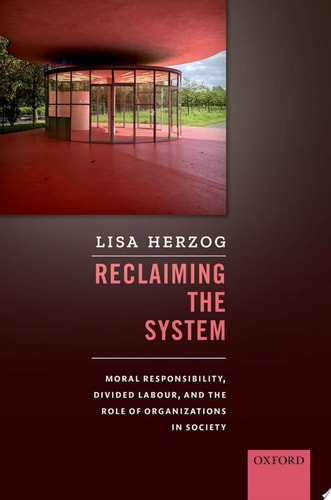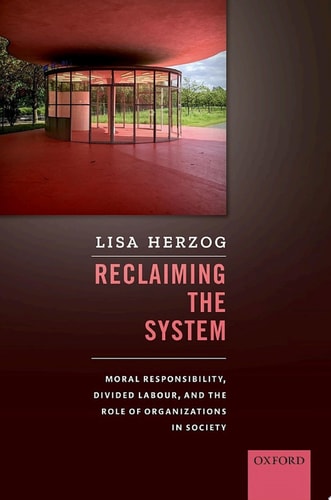
Reclaiming the System: Moral Responsibility, Divided Labour, and the Role of Organizations in Society
0
0
As an Amazon Associate and affiliate partner, Menrva Books earns from qualifying purchases. Learn more
Author Description
The world of wage labour seems to have become a soulless machine, an engine of social and environmental destruction. Employees seem to be nothing but 'cogs' in this system - but is this true? Located at the intersection of political theory, moral philosophy, and business ethics, this book questions the picture of the world of work as a 'system'. Hierarchical organizations, both in the public and in the private sphere, have specific features of their own. This does not mean, however, that they cannot leave room for moral responsibility, and maybe even human flourishing. Drawing on detailed empirical case studies, Lisa Herzog analyses the nature of organizations from a normative perspective: their rule-bound character, the ways in which they deal with divided knowledge, and organizational cultures and their relation to morality. The volume examines how individual agency and organizational structures would have to mesh to avoid common moral pitfalls and develops the notion of 'transformational agency', which refers to a critical, creative way of engaging with one's organizational role while remaining committed to basic moral norms. The volume goes on to explore the political and institutional changes that would be required to re-embed organizations into a just society. Whether we submit to 'the system' or try to reclaim it, Herzog argues, is a question of eminent political importance in our globalized world.
Menrva's Summary
THE THESIS
This book investigates whether the modern structure of wage labor and hierarchical organizations inherently precludes moral responsibility or if individuals can exercise agency to reclaim these systems for the common good. Lisa Herzog, a scholar in political philosophy and economics, utilizes a normative framework to evaluate how organizational structures, such as division of labor and rule-bound hierarchies, interact with individual moral agency. She argues that by understanding the mechanics of these institutions, employees can adopt 'transformational agency' to align their professional roles with broader ethical commitments.
THE SCOPE MAP
What You Will Find
- Normative analysis of organizational structures and rule-bound systems
- Theoretical framework for 'transformational agency' in the workplace
- Empirical case studies examining the intersection of individual action and institutional constraints
- Proposals for political and institutional reform to re-embed organizations into a just society
Scope Limits
- Does not provide a comprehensive manual for corporate management or human resources
- Does not focus on purely economic or market-efficiency metrics
THE AUTHORITY PERSPECTIVE
Experts in political philosophy and business ethics recognize this work as a rigorous contribution to the discourse on institutional morality. Readers frequently note the academic density of the prose, which is best suited for those familiar with normative theory and organizational sociology.
Page Count:
326
Publication Date:
2018-01-01
Publisher:
OUP Oxford
ISBN-10:
019256613X
ISBN-13:
9780192566133
Political Theory
Moral Philosophy
Business Ethics
Sociology
Community Tags
Similar Books