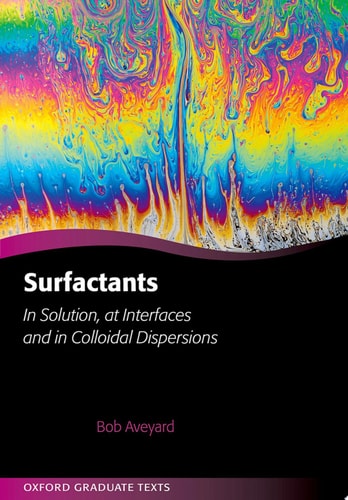
Surfactants: In Solution, at Interfaces and in Colloidal Dispersions
0
0
As an Amazon Associate and affiliate partner, Menrva Books earns from qualifying purchases. Learn more
Author Description
Surfactants... today you have probably eaten some, or rubbed others on your body. Plants, animals (including you) and microorganisms make them, and many everyday products (e.g. detergents, cosmetics, foodstuffs) contain them. Surfactant molecules have one part which is soluble in water and another which is not. This gives surfactant molecules two valuable properties: 1) they adsorb at surfaces (e.g. of an oil droplet in water), and 2) they stick together (aggregate) in water. The aggregates (micelles) are able to dissolve materials not soluble in water alone, and adsorbed surfactant layers, at the surfaces of particles or (say) oil droplets in water, stop the particles or drops sticking together. This is why stable emulsions such as milk do not separate into layers. This book treats the basic physical chemistry and physics underlying the behaviour of surfactant systems. In this book, you will first learn about some background material including hydrophobic hydration, interfacial tension and capillarity (Section I). Discussion of surfactant adsorption at liquid/fluid and solid/liquid interfaces is given in Section II, and includes thermodynamics of adsorption, dynamic and rheological aspects of liquid interfaces and the direct characterisation of surfactant monolayers. In Section III, a description is given of surfactant aggregation to give micelles, lyotropic liquid crystals, microemulsions and Winsor systems. There follows a discussion of surface forces and the way they confer stability on lyophobic colloids and thin liquid films (Section IV). Various dispersions stabilised by adsorbed surfactant or polymer (including solid in liquid dispersions, emulsions and foams) are considered in Section V. The wetting of solids and liquids is explored in Section VI. Like surfactants, small solid particles can adsorb at liquid/fluid interfaces, form monolayers and stabilise emulsions and foams. Such behaviour is covered in Section VII. It is assumed the reader has a knowledge
Menrva's Summary
THE THESIS
This text investigates the fundamental physical chemistry and physics governing the behavior of surfactant systems in various states and environments. Bob Aveyard provides a comprehensive examination of how surfactant molecules function due to their amphiphilic nature, which allows them to adsorb at interfaces and aggregate into micelles. The book utilizes principles of thermodynamics, surface science, and colloid physics to explain how these molecules stabilize emulsions, foams, and dispersions in both biological and industrial contexts.
THE SCOPE MAP
What You Will Find
- Thermodynamic principles of surfactant adsorption at liquid and solid interfaces
- Analysis of micelle formation, lyotropic liquid crystals, and microemulsions
- Examination of surface forces and their role in stabilizing lyophobic colloids
- Investigation of wetting phenomena and the behavior of solid particles at fluid interfaces
Scope Limits
- The text assumes the reader possesses a foundational knowledge of physical chemistry and physics
- It does not focus on the synthesis or industrial manufacturing processes of surfactants
THE AUTHORITY PERSPECTIVE
Experts and students in the field of colloid science frequently cite this work as a rigorous, structured reference for understanding the physical behavior of surfactant systems. Readers often note the academic density of the prose, which is tailored for those with a strong background in chemistry or materials science.
Page Count:
576
Publication Date:
2019-01-01
Publisher:
OUP Oxford
ISBN-10:
0192563750
ISBN-13:
9780192563750
Science
Chemistry
Physical Chemistry
Earth Sciences
Physics
Community Tags
Similar Books